
How to Prospect Shopify Merchants in France: 28,583 Stores with Contact Data
The challenge of prospecting Shopify merchants
If you sell to e-commerce merchants — payment solutions, logistics, SaaS tools, marketing services — you already know that Shopify is one of the fastest-growing platforms in France. But turning that knowledge into a qualified prospect list is another matter entirely.
Public directories and app store listings give you store names and URLs. That is about it. No company registration, no decision-maker name, no email, no phone number, no revenue estimate. You end up spending hours on manual research, enrichment tools that return 40% match rates, and outreach lists full of dead stores and hobbyist projects.
Lebot.in solves this. Our database tracks 28,583 Shopify stores operating in France, each one matched to its SIREN registration, enriched with director contact data, and scored by estimated monthly GMV. This article shows you exactly what data is available and how to use it to build a high-converting prospect list.
The opportunity in numbers
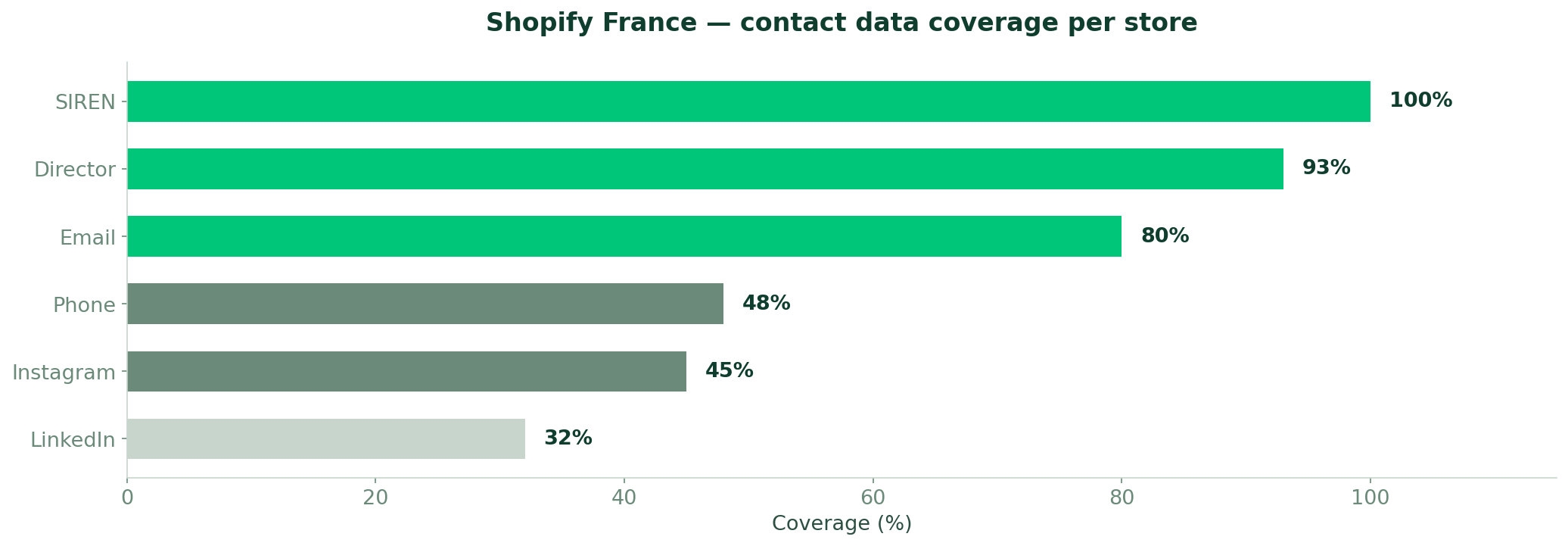
Here is what the Shopify France database looks like at a glance.
| Metric | Value |
|---|---|
| Total Shopify stores (France) | 28,583 |
| SIREN-verified | 100% |
| Director name available | 93% |
| Email available | 80% |
| Phone available | 48% |
| Instagram available | 45% |
| LinkedIn available | 32% |
| Active stores with email | 8,198 (29%) |
| High-value stores with email | 3,717 (13%) |
Two numbers matter most here. First, 8,198 active Shopify stores have a verified email address — that is your actionable outreach base. Second, 3,717 of those are high-value stores (Growing tier and above), meaning they have real revenue and a real need for the services you sell.
How to segment your prospect list
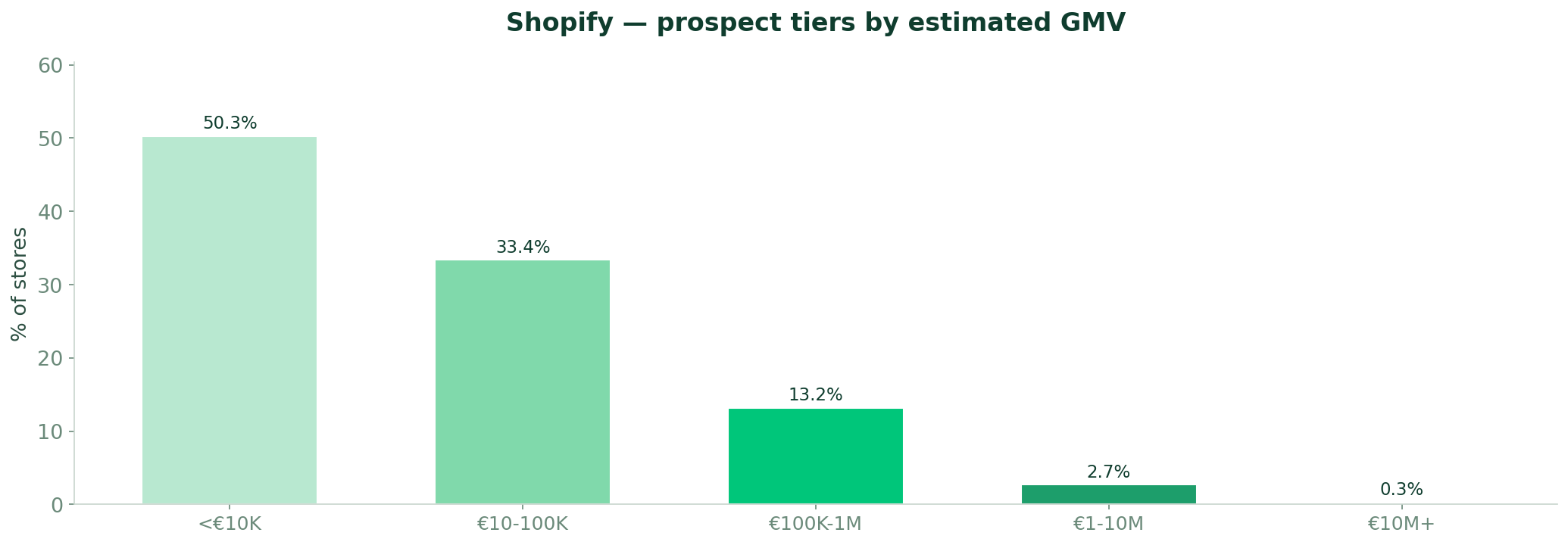
Not every Shopify store is worth prospecting. The database breaks down into five GMV tiers so you can target the right segment for your product.
| Tier | Monthly GMV | Share of stores | Count |
|---|---|---|---|
| Starter | < 10K EUR | 50.3% | ~14,377 |
| Growing | 10K - 100K EUR | 33.4% | ~9,547 |
| Established | 100K - 1M EUR | 13.2% | ~3,773 |
| Leader | 1M - 10M EUR | 2.7% | ~772 |
| Enterprise | 10M+ EUR | 0.3% | ~86 |
If you sell affordable, self-serve tools (email marketing, basic analytics, simple integrations), target the Growing tier. These 9,547 stores have enough revenue to pay for tools but are not yet locked into enterprise contracts.
If you sell mid-market solutions (payment processing, fulfillment, ERP integration), focus on Established and Leader tiers. These 4,545 stores process significant volume and actively look for infrastructure partners.
If you sell enterprise solutions (custom development, high-volume logistics, multi-channel platforms), the 86 Enterprise stores and top Leaders are your targets. Small list, high deal value.
Skip the Starters unless your product has a freemium model or very low price point. Half of Shopify France is sub-10K monthly GMV — many are side projects or early-stage ventures.
Contact data available
The strength of this database is contact depth. Here is what you can work with for outreach.
Email (80% coverage): Four out of five Shopify stores have a verified email address tied to the company or its director. This is your primary outreach channel. With 8,198 active stores reachable by email, you can run meaningful sequences without exhausting your list in a single campaign.
Director name (93% coverage): Nearly every store is linked to a named decision-maker. This lets you personalize subject lines and opening lines — the single biggest driver of cold email open rates.
Phone (48% coverage): About half of Shopify merchants have a phone number on file. Lower than other platforms (PrestaShop hits 82%), but still 13,720 numbers. Useful for follow-up calls after an email open, not as a primary channel.
Instagram (45% coverage): This is where Shopify stands out. Nearly half of Shopify merchants in France have an active Instagram presence. Shopify stores tend to be DTC brands with strong visual identities. If your sales process includes social selling — commenting on posts, sending DMs, building relationships before pitching — this is a rich channel.
LinkedIn (32% coverage): About a third of directors are findable on LinkedIn. Lower than PrestaShop (54%), but still useful for ABM-style outreach on high-value targets.
Recommended channel mix: Lead with email. Use Instagram as a warm-up or parallel touch. Reserve phone for follow-ups on engaged leads. Use LinkedIn selectively for Established and Leader tiers.
Where to find them
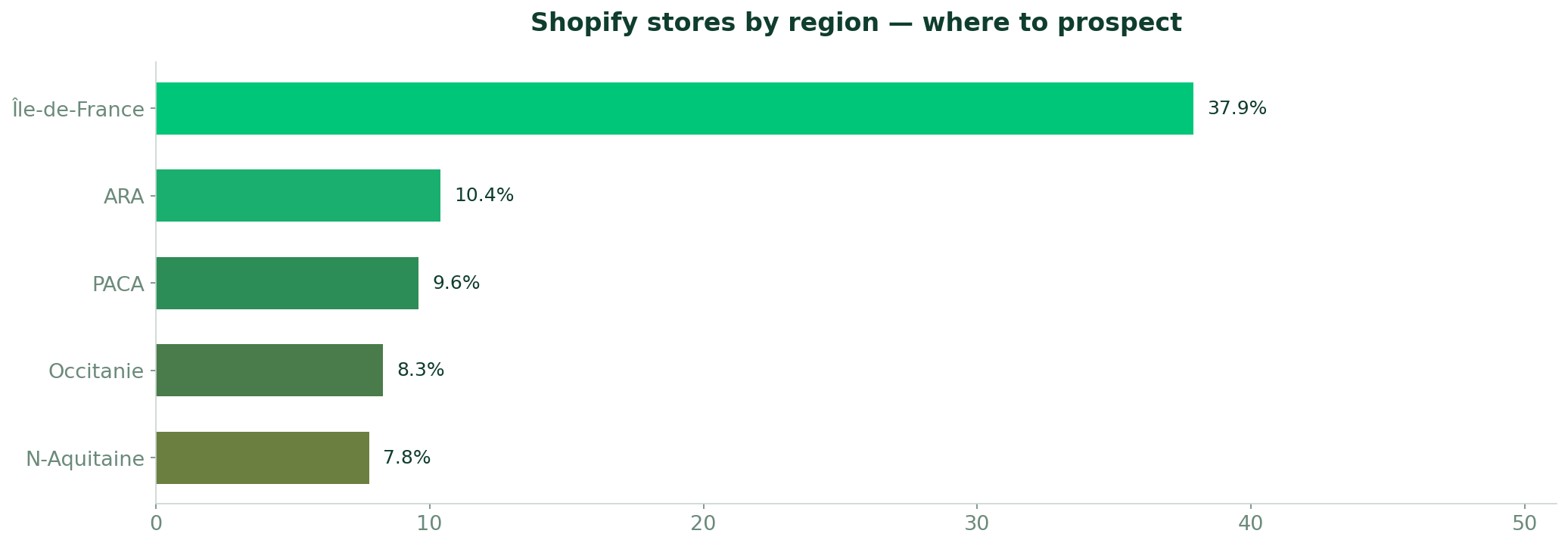
Shopify merchants in France cluster heavily around Paris.
| Region | Share |
|---|---|
| Ile-de-France | 37.9% |
| Auvergne-Rhone-Alpes | 10.4% |
| Provence-Alpes-Cote d'Azur | 9.6% |
| Other regions | 42.1% |
Nearly 40% of French Shopify stores are in Ile-de-France. This is the highest Paris concentration of any major CMS platform. If you are targeting DTC brands, fashion, beauty, or lifestyle e-commerce, filtering for Ile-de-France + Shopify + Growing tier or above will give you a tight, high-quality list.
For regional sales teams or companies with field presence outside Paris, ARA (Lyon, Grenoble) and PACA (Marseille, Nice) are the next best hunting grounds. But be aware that Shopify is more Paris-centric than PrestaShop or WooCommerce — if you need national distribution, consider adding other platforms to your targeting.
Company profile
Understanding who these merchants are helps you tailor your pitch.
Legal structure: 40% are SAS (simplified joint-stock companies), 40% are EI (sole proprietors / auto-entrepreneurs). This split tells you something important: Shopify France is polarized between professional companies and solo operators. When prospecting, the SAS stores are more likely to have budget, procurement processes, and multi-person teams. The EI stores are one-person operations — faster decisions, smaller budgets.
Company size: 78% are PME (small and medium enterprises). Very few ETI (mid-size) or large companies. You are mostly talking to founders, owners, and small teams.
Age and maturity: Shopify merchants in France tend to be younger companies. Many launched in the last 3-5 years, riding the DTC wave. They are digitally native, comfortable with SaaS tools, and used to buying online. They respond well to modern sales approaches — clean emails, product demos, free trials.
Recommended prospecting approach for Shopify merchants
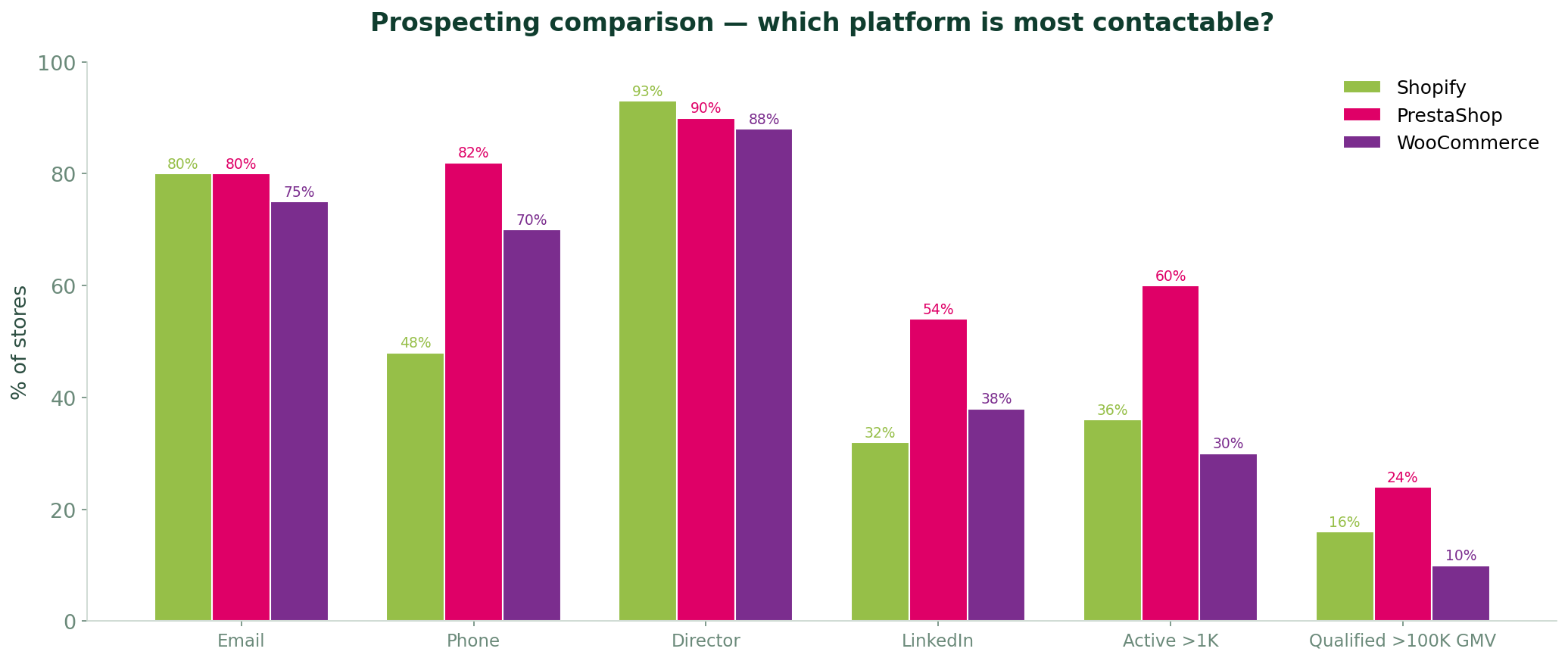
Based on the data profile, here is a practical GTM playbook for Shopify France.
Primary channel: Email sequences. With 80% email coverage and a digitally native audience, structured email campaigns are your best bet. Build a 4-5 touch sequence over 2-3 weeks. Personalize with the director's name and store name. Reference their Shopify stack if relevant.
Secondary channel: Instagram social selling. With 45% Instagram coverage, you have a unique opportunity. Follow target accounts, engage with their content for a week, then DM with a value-oriented message. This works especially well for marketing services, design tools, and anything visual.
Follow-up channel: Phone. Use phone for warm follow-ups only. Call after an email open or a website visit. Cold calling Shopify merchants (who are often solo operators working from home) has low conversion rates.
ABM for high-value targets: For Established and Leader stores, combine LinkedIn outreach with email. These larger operations have more structured buying processes and respond well to multi-channel, personalized approaches.
Timing: Avoid major sale periods (Black Friday prep in October-November, January sales). Best outreach windows are February-April and September-October.
How to get started
The lebot.in database lets you filter Shopify merchants by every dimension covered in this article: CMS platform, region, GMV tier, company size, legal form, and sector.
You can export a targeted list with the contact fields you need — director name, email, phone, social profiles — and load it directly into your CRM or outreach tool.
Start by defining your ICP: which GMV tier, which regions, which company types. Then pull the filtered list and build your sequence. With 8,198 actionable Shopify prospects (active stores with email), you have enough volume for sustained prospecting without burning through your market in a single quarter.
Access the database at lebot.in.
Frequently asked questions
How many Shopify stores are there in France?
As of our latest crawl, we track 28,583 Shopify stores operating in France. Each store is matched to a French SIREN company registration, so hobbyist sites and international stores without a French entity are excluded.
Can I get email addresses for Shopify merchants in France?
Yes. 80% of Shopify stores in our database have a verified email address. Of the active stores (those showing recent traffic and transactions), 8,198 have email — that is 29% of the total base ready for outreach.
How often is the data updated?
The database is updated through continuous crawling and periodic enrichment passes. Store activity status, contact information, and GMV estimates are refreshed regularly to minimize bounce rates and outdated records.
Can I filter by region or business sector?
Yes. You can filter by French region (Ile-de-France, ARA, PACA, etc.), by business sector, by company size (PME, ETI), by legal form (SAS, SARL, EI), and by GMV tier. Combine filters to build a precise target list.
What makes this different from scraping Shopify store directories?
Three things: SIREN verification (every store is matched to a real French company), contact enrichment (director names, emails, phones, social profiles at rates far above what enrichment tools achieve on raw URLs), and GMV scoring (so you can filter out stores that are too small or too large for your offer).
Methodology
The lebot.in database is built through a multi-step process. First, we identify active e-commerce stores operating on Shopify in France through technology detection on indexed domains. Second, we match each store to its French company registration (SIREN) using domain ownership, legal mentions, and company registry cross-referencing. Third, we enrich each record with director identity, contact information, and social profiles from public and commercial sources. Finally, we estimate monthly GMV using a proprietary model based on traffic signals, product catalog depth, pricing, and third-party commerce indicators. All data is collected and processed in compliance with GDPR and French data protection regulations.

Your prospects are in our database. Let's talk.
Our team is available to present the solution and help you build your first e-commerce prospect segment.
Book a meeting →