French E-commerce Database: 155,000 Online Stores Mapped by Platform, Region, and Legal Entity
The missing layer in French e-commerce intelligence
France is the second-largest e-commerce market in Europe, yet reliable data on the businesses behind the storefronts has been remarkably difficult to obtain. Publicly available statistics tend to report aggregate transaction volumes or consumer behavior trends. They rarely answer the questions that matter most to B2B teams: how many online stores actually operate in France, which platforms do they use, where are they located, and can each one be traced to a verified legal entity?
That gap exists because no single source has combined granular, store-level technology detection with official French business registration data at scale. Market reports cite estimates. Platform vendors publish selective metrics. Directory scrapes deliver incomplete records with no legal verification.
lebot.in’s June 2026 database closes that gap. It maps 155,000 active e-commerce businesses operating in France, each matched to its SIREN — the nine-digit French legal entity registration number assigned by INSEE, roughly equivalent to a UK Companies House number or a US EIN. With 137,821 unique SIRENs identified at a 100% match rate across 134 data columns per record, this is the most comprehensive verified census of French online retail available today.
This article draws entirely on that dataset. Every figure cited below comes from the lebot.in June 2026 database unless otherwise noted.
E-commerce platform market share in France: June 2026
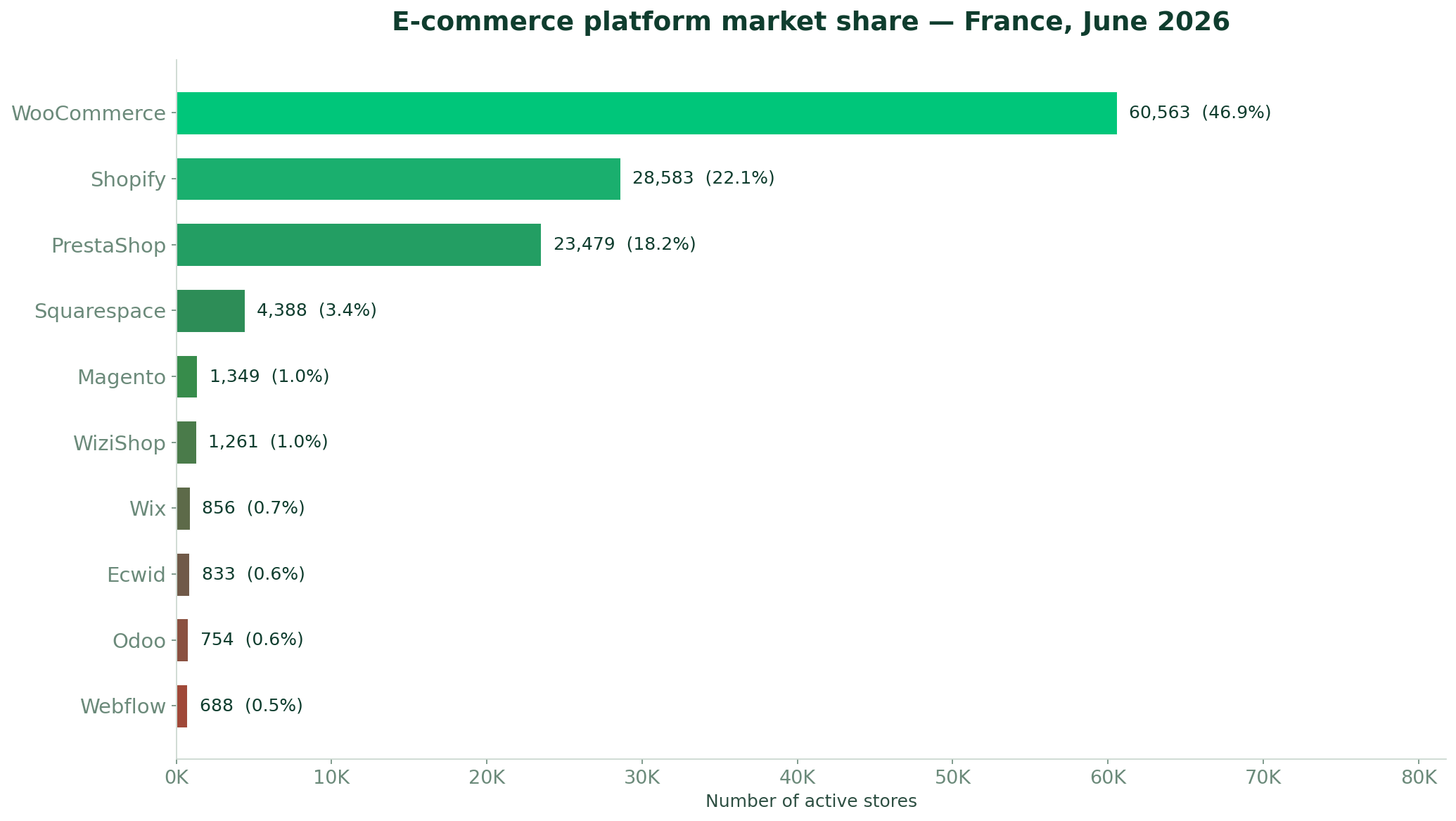
The French e-commerce platform landscape is dominated by three players that collectively account for 87% of all identified installations.
WooCommerce leads, but its dominance varies by geography
WooCommerce powers 60,563 stores, representing 46.9% of all e-commerce sites in France where a platform could be identified. Its market share is built on the WordPress ecosystem, low entry cost, and a deep bench of French-language plugins and agencies.
Shopify holds the second position with 28,583 stores (22.1%). Its growth trajectory in France has been steep over the past three years, particularly in the Paris region, where its share nearly matches WooCommerce — a pattern that diverges sharply from the national average.
PrestaShop, the only major CMS with French origins, retains a strong third position at 23,479 stores (18.2%). Despite losing ground to Shopify in recent years, PrestaShop continues to hold a loyal base among established French merchants, especially outside Ile-de-France.
Shopify vs WooCommerce in France: what the data actually shows
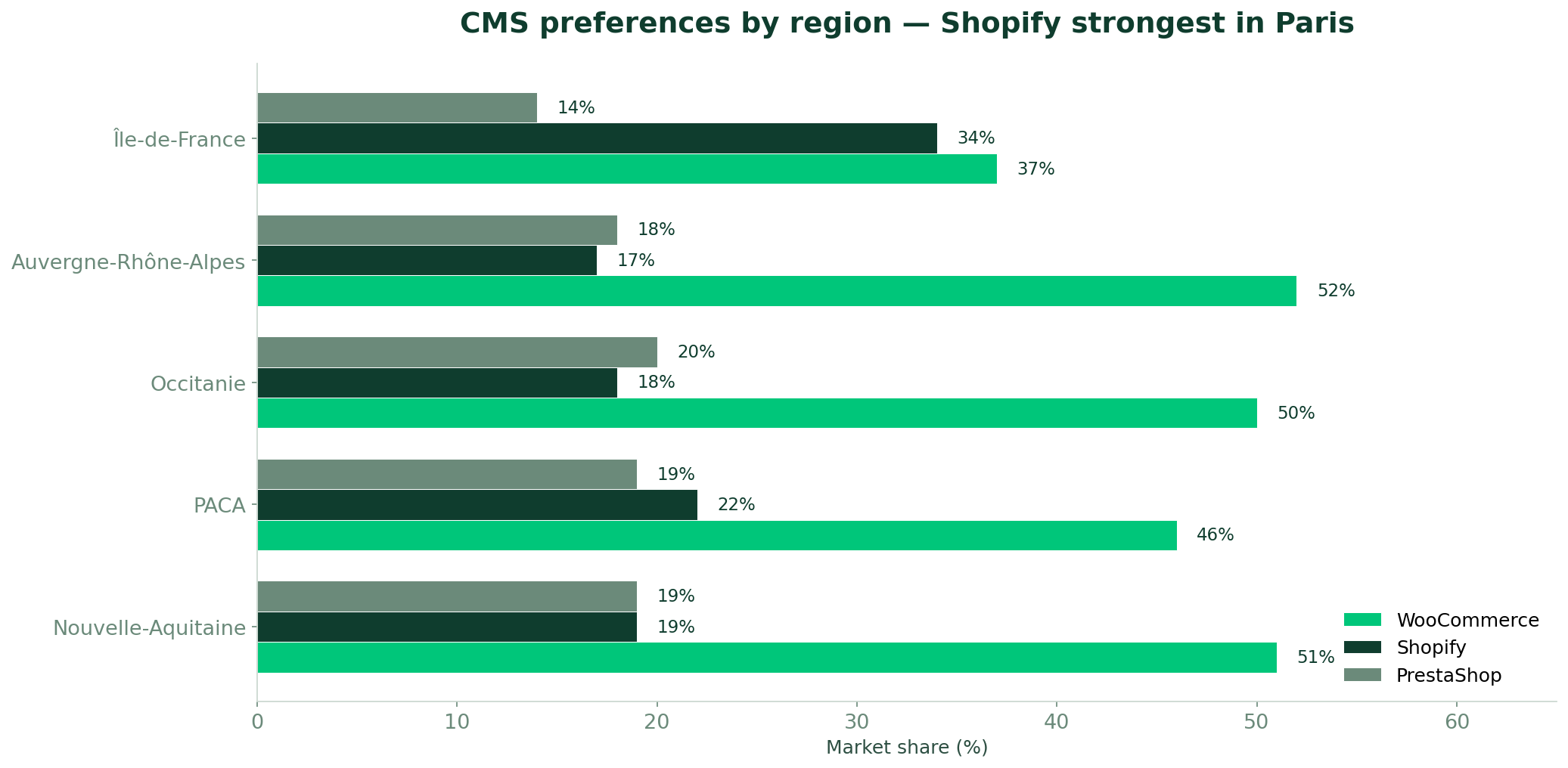
The debate over Shopify versus WooCommerce is one of the most searched comparison queries in French e-commerce. The data reveals a more nuanced picture than a simple national ranking suggests.
At the national level, WooCommerce holds a two-to-one advantage over Shopify (46.9% vs 22.1%). But in Ile-de-France, that gap narrows dramatically: WooCommerce drops to 37% while Shopify climbs to 34%. In every other region, WooCommerce maintains at least a 28-percentage-point lead.
The implication is clear. Shopify’s adoption in France is heavily concentrated in the Paris metropolitan area, where younger, venture-backed, and digitally native brands are more common. Outside the capital, WooCommerce and PrestaShop remain the default choices for the vast majority of French online merchants.
PrestaShop’s position in 2026
PrestaShop’s 18.2% share places it firmly in the top three, but its trajectory is worth watching. While it remains the preferred platform for established small and mid-size merchants — particularly in southern and eastern France — its share among stores created since 2022 has declined relative to Shopify. The June 2026 database shows PrestaShop holding 20% market share in Occitanie and 19% in PACA, compared to Shopify’s 18% and 22% in the same regions.
For teams evaluating PrestaShop versus Shopify in the French market, the distinction is less about which platform is “better” and more about which merchant segment you are targeting. PrestaShop skews toward mature, self-hosted businesses. Shopify attracts newer entrants and brands prioritizing speed to market.
Regional distribution: where France sells online
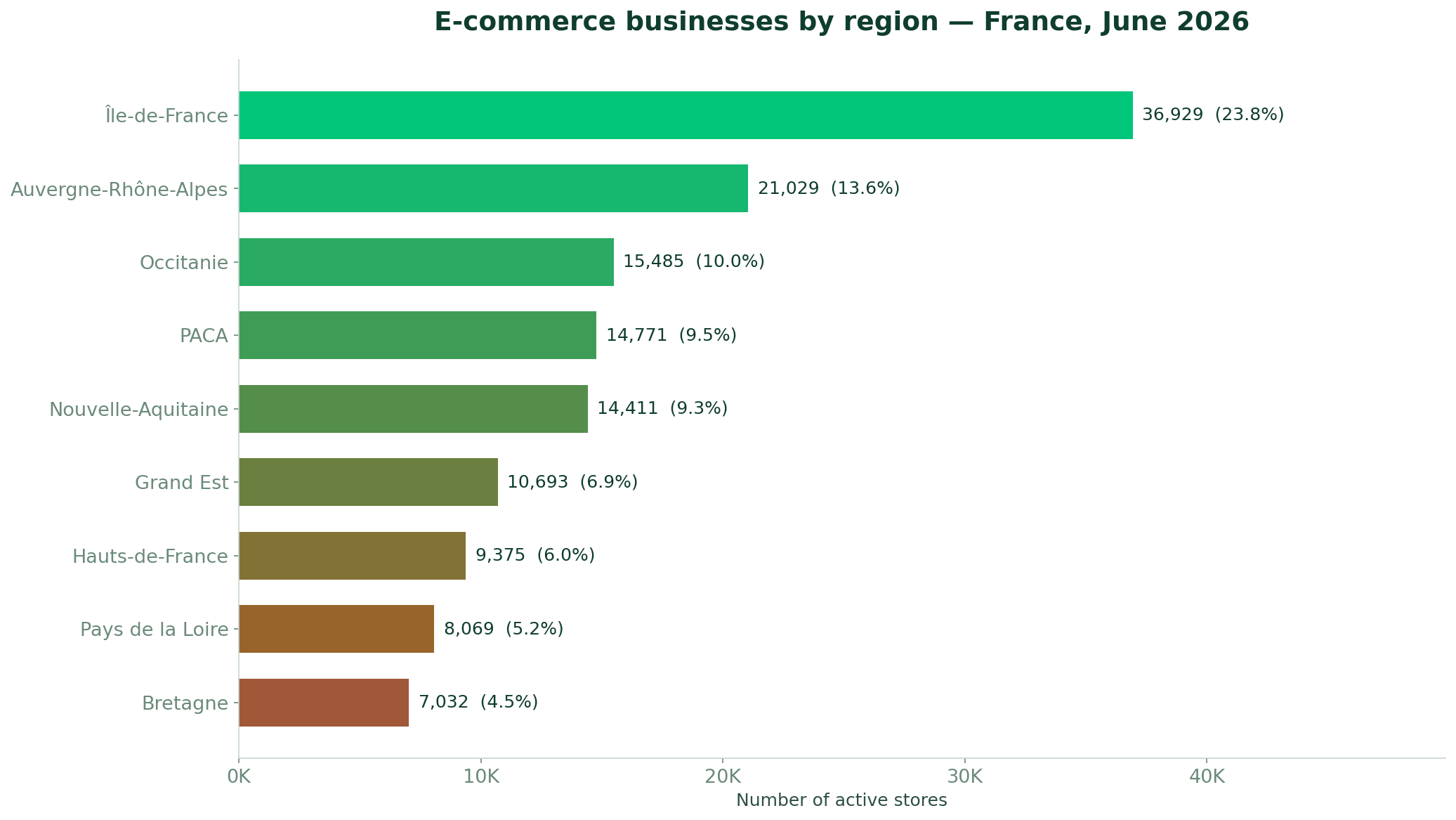
French e-commerce activity is concentrated in a handful of regions, with a pronounced Paris effect that shapes everything from platform choice to company demographics.
Nearly one in four French online stores is registered in Ile-de-France (36,929 stores, 23.8%). Auvergne-Rhone-Alpes follows with 21,029 (13.6%), then Occitanie (15,485, 10.0%), PACA (14,771, 9.5%), and Nouvelle-Aquitaine (14,411, 9.3%). The top five regions account for 66% of all e-commerce businesses nationally.
This pattern has direct implications for any company selling to French merchants. A payment processor, logistics provider, or app developer targeting Shopify stores should focus acquisition efforts disproportionately on Ile-de-France. A WooCommerce agency, by contrast, will find its largest addressable market in the regions surrounding Lyon, Toulouse, Marseille, and Bordeaux.
Company demographics: who runs French e-commerce

The lebot.in database includes verified legal entity data for every record, making it possible to profile the businesses behind French online stores — not just their technology stacks.
Company size: overwhelmingly small and mid-size
The French e-commerce landscape is a PME (small and mid-size enterprise) market. 84% of all businesses in the database are classified as PME. ETI (mid-cap companies) account for 3.3%, and large enterprises represent just 0.8%. Selling to French e-commerce businesses means selling to small companies, often owner-operated, with lean teams and limited procurement processes.
Legal structure: SAS dominates, but sole proprietors are a large segment

The SAS (Société par Actions Simplifiée) is the most common legal structure at 37.1%, consistent with its popularity among tech-oriented French startups and SMBs. But the nearly 29% share held by sole proprietors (entrepreneurs individuels) reflects the long tail of micro-businesses operating a single online store. SARL (Société à Responsabilité Limitée) accounts for 26.7%.
The COVID creation boom and its aftermath
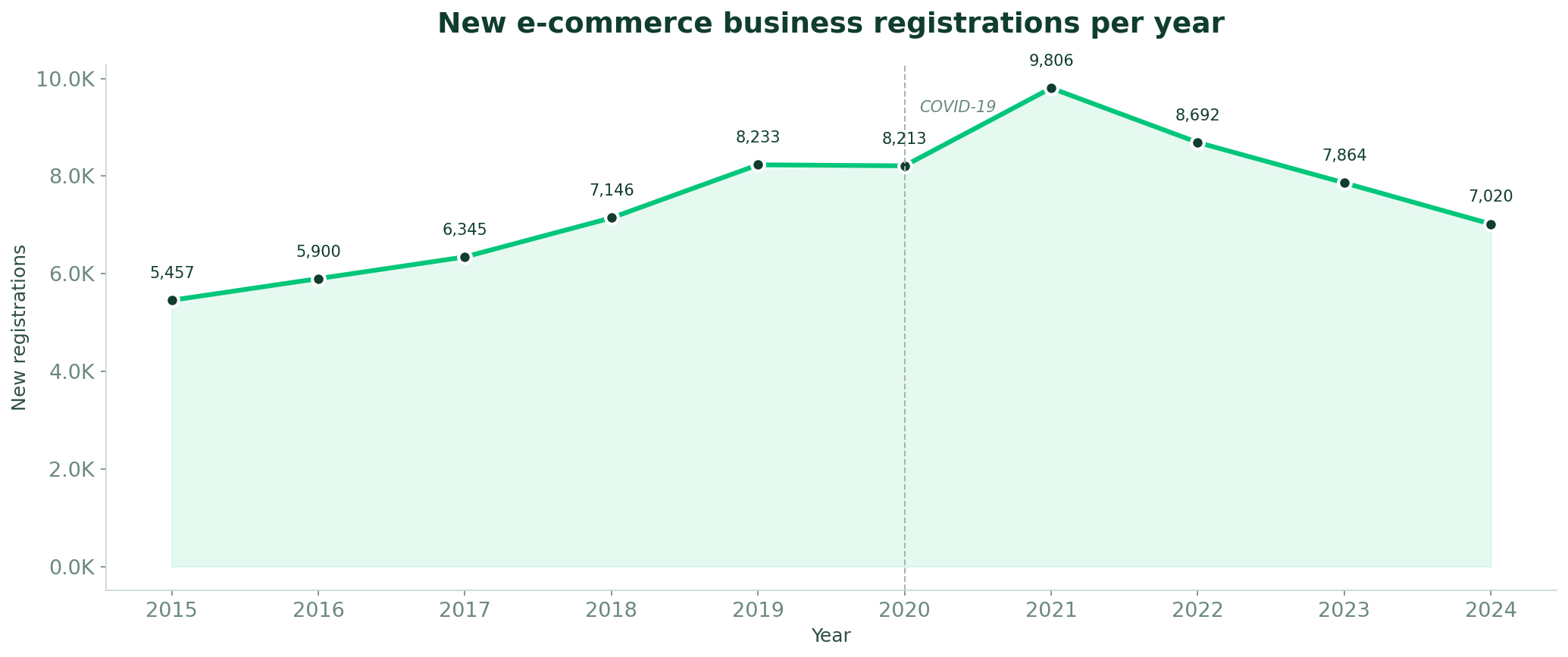
Company creation data reveals a clear COVID-era spike. Business registrations linked to e-commerce activity peaked at 9,806 new entities in 2021, driven by the rapid digitization of retail during lockdowns. Since then, annual creation volumes have declined steadily, reaching 7,020 in 2024. This trajectory suggests the market is entering a consolidation phase. The low-hanging fruit of pandemic-driven digital adoption has been picked. Growth in the number of e-commerce businesses is decelerating, which means the existing installed base — the 155,000 active stores already operating — becomes the primary addressable market for B2B vendors.
Technology ecosystem: marketplace presence and estimated GMV
A significant subset of French e-commerce businesses sell on marketplaces in addition to their own stores. The June 2026 database identifies 9,697 stores with a presence on Cdiscount and 4,037 on Amazon France. These multichannel sellers represent a high-value segment for logistics providers, repricing tools, and inventory management platforms.
Estimated gross merchandise volume
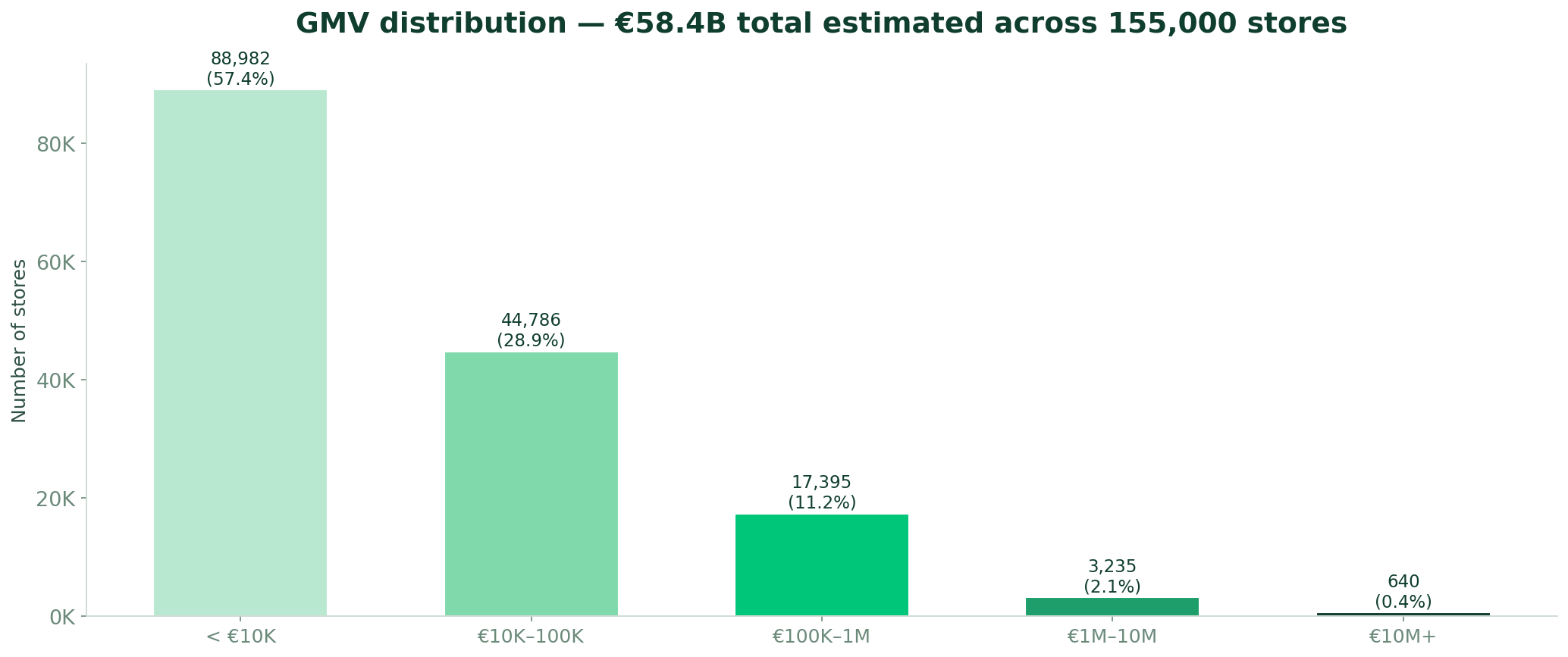
The total estimated GMV across all 155,000 stores in the database is EUR 58.4 billion. The distribution is heavily skewed: 57.4% of stores generate less than EUR 10,000, while the 2.6% exceeding EUR 1 million collectively account for a disproportionate share of total transaction volume. For B2B vendors, this distribution underscores the importance of segmentation.
What a verified French e-commerce database includes
The lebot.in database is structured for immediate use in sales prospecting, market analysis, and competitive intelligence. Each of the 155,000 records includes up to 134 data columns.
Identification and legal data
Every record is anchored by a verified SIREN, the official nine-digit registration number issued by France’s national statistics institute (INSEE). This allows users to cross-reference any store with official filings, financial statements, and legal records. The database also includes company name, legal form, date of registration, registered address, and NAF/APE activity code.
Contact and decision-maker data
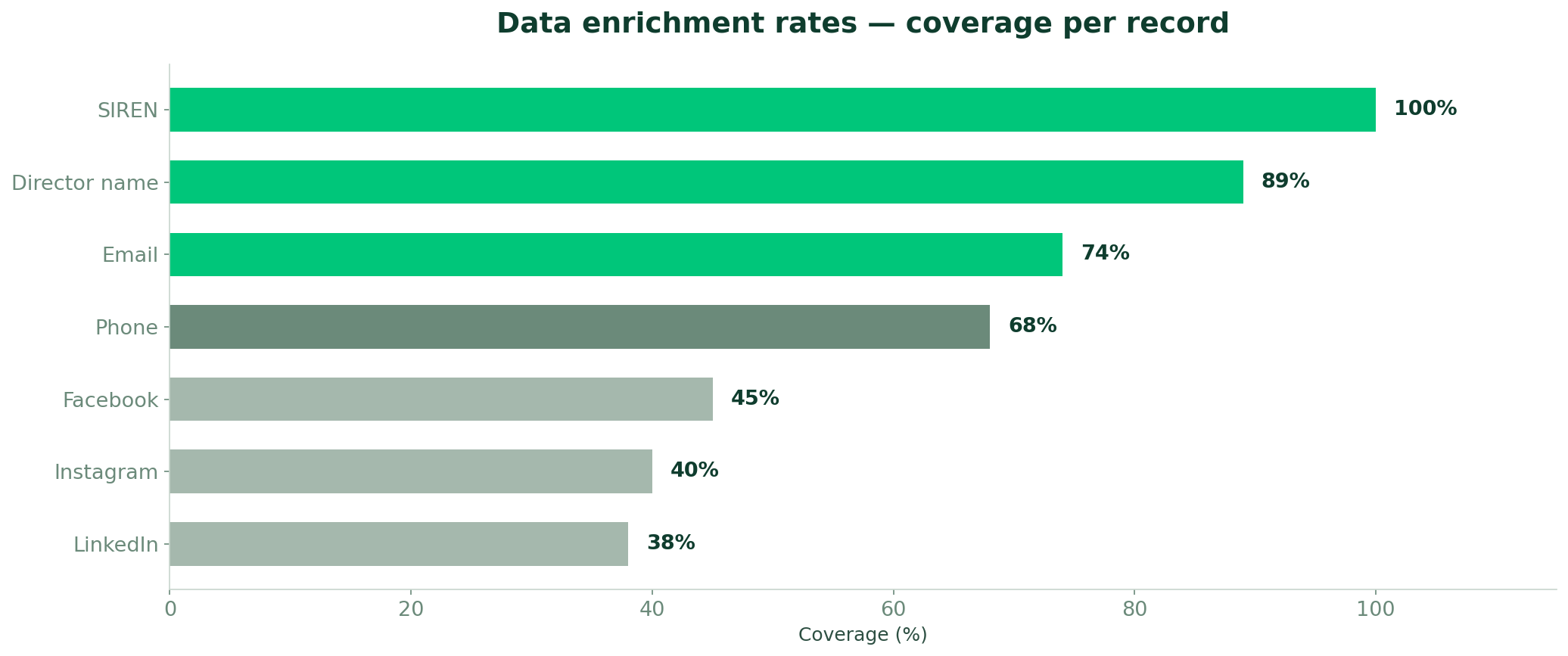
Enrichment rates: SIREN 100%, Director name 89%, Email 74%, Phone 68%, Facebook 45%, Instagram 40%, LinkedIn 38%. An 89% director name coverage rate and 74% email rate mean that the majority of records are immediately actionable for outbound sales campaigns.
Why SIREN matching matters
A database of e-commerce URLs without legal entity verification is a list of websites. A SIREN-matched database is a list of businesses. First, deduplication: some businesses operate multiple domains. The 155,000 stores map to 137,821 unique SIRENs, meaning approximately 11% of businesses run more than one online store. Second, compliance: GDPR-compliant B2B outreach in France requires knowing who you are contacting. Third, enrichment: a SIREN unlocks the entire French corporate data ecosystem.
Use cases: who needs a French e-commerce database and why
SaaS vendors and app developers
If your product integrates with Shopify, WooCommerce, or PrestaShop, the database gives you a segmented prospect list filtered by platform, region, estimated GMV, and technology stack.
Logistics and fulfillment companies
Regional distribution data allows logistics providers to match warehouse capacity with merchant density. Marketplace sellers (9,697 on Cdiscount, 4,037 on Amazon) represent a segment with inherently complex fulfillment needs.
Market researchers and consultants
The 134-column dataset supports custom analysis across dimensions that public market reports do not cover: CMS adoption by region, company age by platform, multichannel behavior by legal structure.
Private equity and M&A teams
The combination of legal entity data, estimated GMV, company age, and technology stack makes the database a screening tool for acquisition targets.
Frequently asked questions
How many e-commerce businesses are there in France in 2026?
According to lebot.in’s June 2026 database, there are 155,000 active e-commerce businesses operating in France, corresponding to 137,821 unique SIREN-verified legal entities.
What is the most popular e-commerce platform in France?
WooCommerce is the most widely used e-commerce platform in France, powering 60,563 stores (46.9% market share). Shopify ranks second with 28,583 stores (22.1%), followed by PrestaShop with 23,479 stores (18.2%). However, in Ile-de-France, Shopify nearly matches WooCommerce at 34% vs 37%.
How does Shopify compare to WooCommerce in the French market?
Nationally, WooCommerce holds a two-to-one advantage over Shopify (46.9% vs 22.1%). The gap narrows sharply in Paris and Ile-de-France, where Shopify reaches 34% market share compared to WooCommerce’s 37%. The choice between the two often correlates with business maturity and geographic location.
What is a SIREN and why does it matter for e-commerce data?
A SIREN is a nine-digit legal entity registration number assigned by INSEE, France’s national statistics institute. SIREN matching ensures that each store in the database is tied to a verified legal entity, enabling deduplication, GDPR-compliant outreach, and cross-referencing with official financial and legal filings.
What regions have the highest concentration of e-commerce businesses in France?
Ile-de-France leads with 36,929 stores (23.8%). Auvergne-Rhone-Alpes follows with 21,029 (13.6%), then Occitanie (15,485, 10.0%), PACA (14,771, 9.5%), and Nouvelle-Aquitaine (14,411, 9.3%). Together, these five regions account for two-thirds of all French e-commerce activity.
How can I access the lebot.in French e-commerce database?
The full 155,000-record database with 134 data columns per entry is available through lebot.in. Contact the team at lebot.in to request a sample or discuss licensing options.
Methodology and scope
The lebot.in June 2026 database covers active e-commerce businesses operating in France with a detectable online checkout. Stores are identified through continuous web crawling and technology fingerprinting, then matched to their SIREN via cross-referencing with official French business registries. The database is updated monthly. All 155,000 records carry a verified SIREN.
Related articles
→ Shopify in France — May 2026: 28,228 stores and €5.6B estimated annual revenue
→ PrestaShop in France — May 2026: 23,366 stores and €5.9B estimated annual GMV
→ StoreLeads Alternative: 78% of Shopify France data is unusable
→ French E-commerce Panorama — April 2026
The data cited in this article is drawn from lebot.in’s June 2026 database of French e-commerce businesses. For access to the full dataset, sample records, or custom analysis, visit lebot.in.

Your prospects are in our database. Let's talk.
Our team is available to present the solution and help you build your first e-commerce prospect segment.
Book a meeting →