.jpg)
Shopify vs WooCommerce in France: 28,583 vs 60,563 Stores — What the Data Actually Shows
The comparison that actually matters
WooCommerce powers more than twice as many online stores as Shopify in France. That fact alone ends most comparisons before they begin. But store count is a misleading proxy for market dominance when the two platforms serve fundamentally different merchant populations with different revenue profiles, different industry mixes, and different geographic footprints.
Shopify generates three times the revenue per store. It captures a disproportionate share of high-traffic Leaders. Its merchants are younger, more concentrated in Paris, and overwhelmingly focused on retail commerce. WooCommerce, by contrast, is the platform of provincial France, of non-retail businesses that happen to sell online, of older companies running .fr domains on self-hosted WordPress installations. The real story is not which platform is bigger. It is why the two platforms attracted such different populations in the first place.
This article uses lebot.in’s June 2026 database of 155,000 SIREN-verified French e-commerce businesses to compare the installed base of Shopify and WooCommerce across traffic, revenue, industry, geography, and company structure. Every figure below comes from that dataset. There are no feature comparisons, no pricing tables, and no recommendations disguised as analysis. Just the data.
Scorecard: key metrics head to head
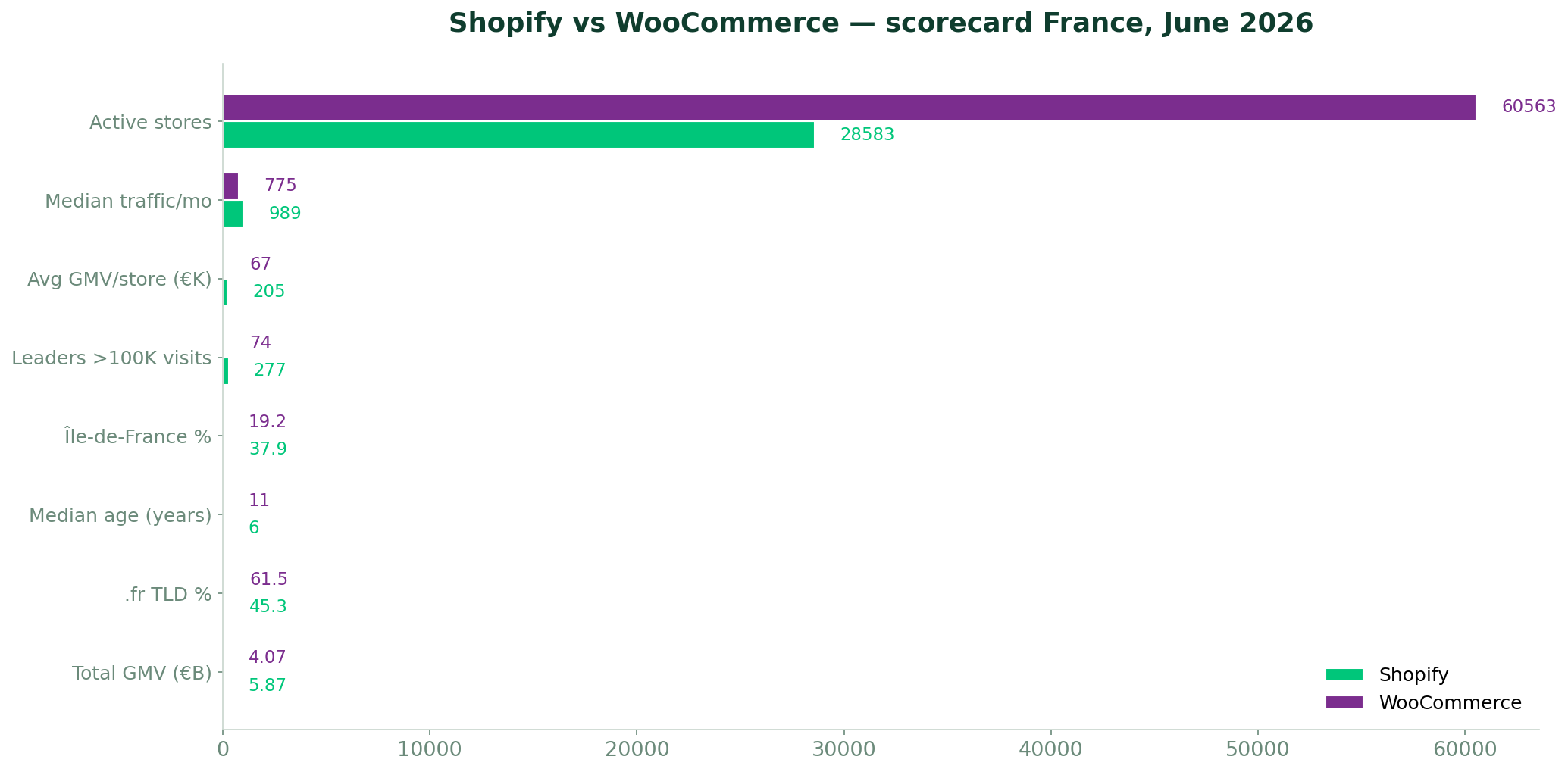
Before diving into the details, here is the summary comparison across eight dimensions that define each platform’s position in France.
| Metric | Shopify | WooCommerce |
|---|---|---|
| Active stores | 28,583 | 60,563 |
| Market share (France) | 22.1% | 46.9% |
| Median monthly traffic | 989 | 775 |
| Total estimated GMV | 5.87B EUR | 4.07B EUR |
| Average GMV per store | 205,272 EUR | 67,236 EUR |
| Stores with >100K visits/mo | 277 | 74 |
| Median company age | 6 years | 11 years |
| Ile-de-France concentration | 37.9% | 19.2% |
The scorecard tells two contradictory stories depending on which column you read first. WooCommerce dominates by volume: 60,563 stores, nearly 47% of the entire French e-commerce market, more than double Shopify’s count. But Shopify dominates by revenue intensity: 205,272 EUR average GMV per store versus 67,236 EUR on WooCommerce — a 3.1x gap. Despite having half the stores, Shopify’s total platform GMV (5.87 billion EUR) exceeds WooCommerce (4.07 billion EUR) by 44%.
The Leaders metric is the most striking line in the table. Shopify has 277 stores receiving more than 100,000 monthly visits. WooCommerce has 74. That is 3.7 times more top-tier stores on a platform with less than half the total base. WooCommerce’s massive install count masks a revenue and traffic distribution that is far more bottom-heavy than Shopify’s.
Traffic and performance distribution
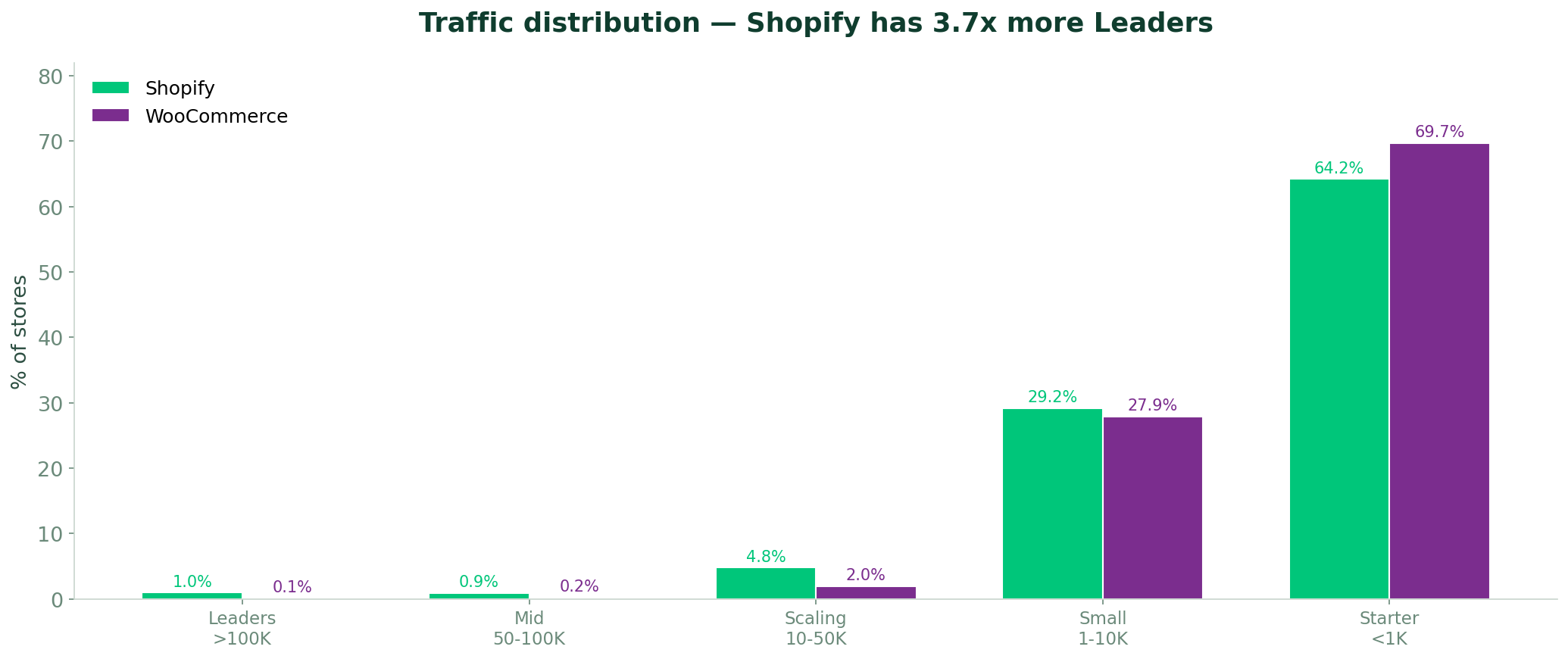
Raw store counts reveal market presence. Traffic distribution reveals market substance — whether a platform’s base is actively trading or mostly dormant.
Shopify traffic segments
| Segment | Monthly visits | Share of stores |
|---|---|---|
| Starters | <1,000 | 64.2% |
| Small | 1,000--10,000 | 29.2% |
| Scaling | 10,000--40,000 | 4.8% |
| Mid-market | 40,000--100,000 | 0.9% |
| Leaders | >100,000 | 1.0% |
WooCommerce traffic segments
| Segment | Monthly visits | Share of stores |
|---|---|---|
| Starters | <1,000 | 69.7% |
| Small | 1,000--10,000 | 27.9% |
| Scaling | 10,000--40,000 | 2.0% |
| Mid-market | 40,000--100,000 | 0.2% |
| Leaders | >100,000 | 0.1% |
WooCommerce has an even higher concentration of micro-stores than Shopify: 69.7% of WooCommerce stores receive fewer than 1,000 monthly visits, compared to 64.2% on Shopify. Both platforms are dominated by Starters, but WooCommerce’s Starter share is five percentage points heavier.
The gap widens dramatically at the top. Shopify holds 4.8% of its stores in the Scaling tier (10,000--40,000 visits), more than double WooCommerce’s 2.0%. At the Mid-market level, Shopify has 0.9% versus WooCommerce’s 0.2%. And at the Leaders tier, Shopify’s 1.0% translates to 277 stores with over 100,000 monthly visits, while WooCommerce’s 0.1% yields only 74.
Shopify’s distribution is bimodal. It has a large base of micro-stores at the bottom and a disproportionate concentration of high-traffic stores at the top. WooCommerce’s distribution is monotonically declining — heavy at the bottom, thin everywhere else. For any business selling services to high-traffic merchants, Shopify offers a richer target pool despite its smaller total base.
Industry verticals
The industry composition of each platform’s merchant base is where the most fundamental difference emerges. Shopify is an e-commerce platform. WooCommerce is a WordPress plugin that happens to handle transactions.
Shopify: top sectors by NAF code classification
| Sector | Share of stores |
|---|---|
| Commerce (retail/wholesale) | 57.2% |
| Manufacturing | 18.0% |
| Professional services | 6.3% |
| IT and communications | 4.6% |
WooCommerce: top sectors by NAF code classification
| Sector | Share of stores |
|---|---|
| Commerce (retail/wholesale) | 29.8% |
| Manufacturing | 16.3% |
| Professional services | 9.2% |
| IT and communications | 8.6% |
| Other services | 7.4% |
| Arts and leisure | 5.1% |
WooCommerce is vastly more diversified than Shopify. Only 29.8% of WooCommerce stores are classified under Commerce, compared to 57.2% on Shopify. That means more than 70% of WooCommerce stores belong to businesses whose primary activity is not retail trade.
The sectors that fill WooCommerce’s long tail are revealing. IT and communications holds 8.6% of WooCommerce stores versus 4.6% on Shopify. Professional services reaches 9.2% versus 6.3%. Arts and leisure accounts for 5.1% of WooCommerce stores — a segment that barely registers on Shopify. Other services, a broad category covering consulting, training, and business support, holds 7.4% of the WooCommerce base.
WooCommerce is the platform of non-retail businesses that happen to sell online. A web agency that also sells hosting packages. A training company that takes course registrations. An IT consultancy that licenses software. These businesses already run WordPress for their corporate site and bolt on WooCommerce when they need a checkout. They are not choosing between Shopify and WooCommerce. They are choosing between WooCommerce and not selling online at all.
Geography: where each platform dominates
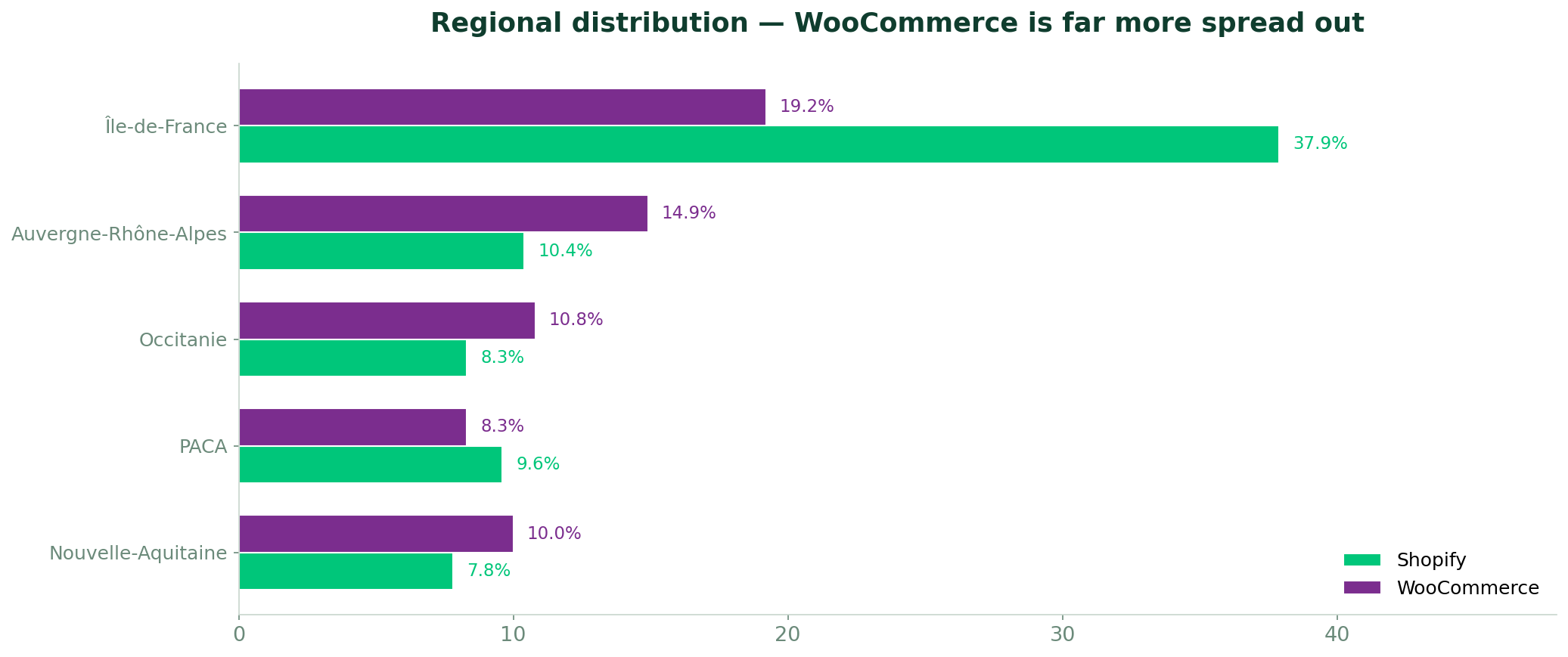
The geographic footprints of Shopify and WooCommerce mirror their merchant profiles. One is Parisian. The other is provincial.
Shopify: regional distribution
| Region | Share of stores |
|---|---|
| Ile-de-France | 37.9% |
| Auvergne-Rhone-Alpes | 10.4% |
| Provence-Alpes-Cote d'Azur | 9.6% |
| Occitanie | 8.3% |
| Nouvelle-Aquitaine | 7.8% |
WooCommerce: regional distribution
| Region | Share of stores |
|---|---|
| Ile-de-France | 19.2% |
| Auvergne-Rhone-Alpes | 14.9% |
| Occitanie | 10.8% |
| Nouvelle-Aquitaine | 10.0% |
| Provence-Alpes-Cote d'Azur | 9.5% |
Shopify’s Ile-de-France concentration is exactly double WooCommerce’s: 37.9% versus 19.2%. Nearly two in five French Shopify stores are registered in the Paris region. On WooCommerce, fewer than one in five.
Outside Paris, WooCommerce holds a larger share in every major region. Auvergne-Rhone-Alpes: 14.9% versus 10.4%. Occitanie: 10.8% versus 8.3%. Nouvelle-Aquitaine: 10.0% versus 7.8%. WooCommerce is the most geographically distributed major platform in France, more balanced than either PrestaShop or Shopify.
This distribution is not accidental. WooCommerce adoption in provincial France is driven by the WordPress agency ecosystem. Local web developers and small agencies in regional cities have historically built client sites on WordPress. When those clients need e-commerce capability, WooCommerce is the natural extension — no new platform to learn, no migration required, no dependency on a Paris-based SaaS vendor. The result is a merchant base that follows the distribution of French small businesses, not the distribution of French tech startups.
Company profile: who uses each platform
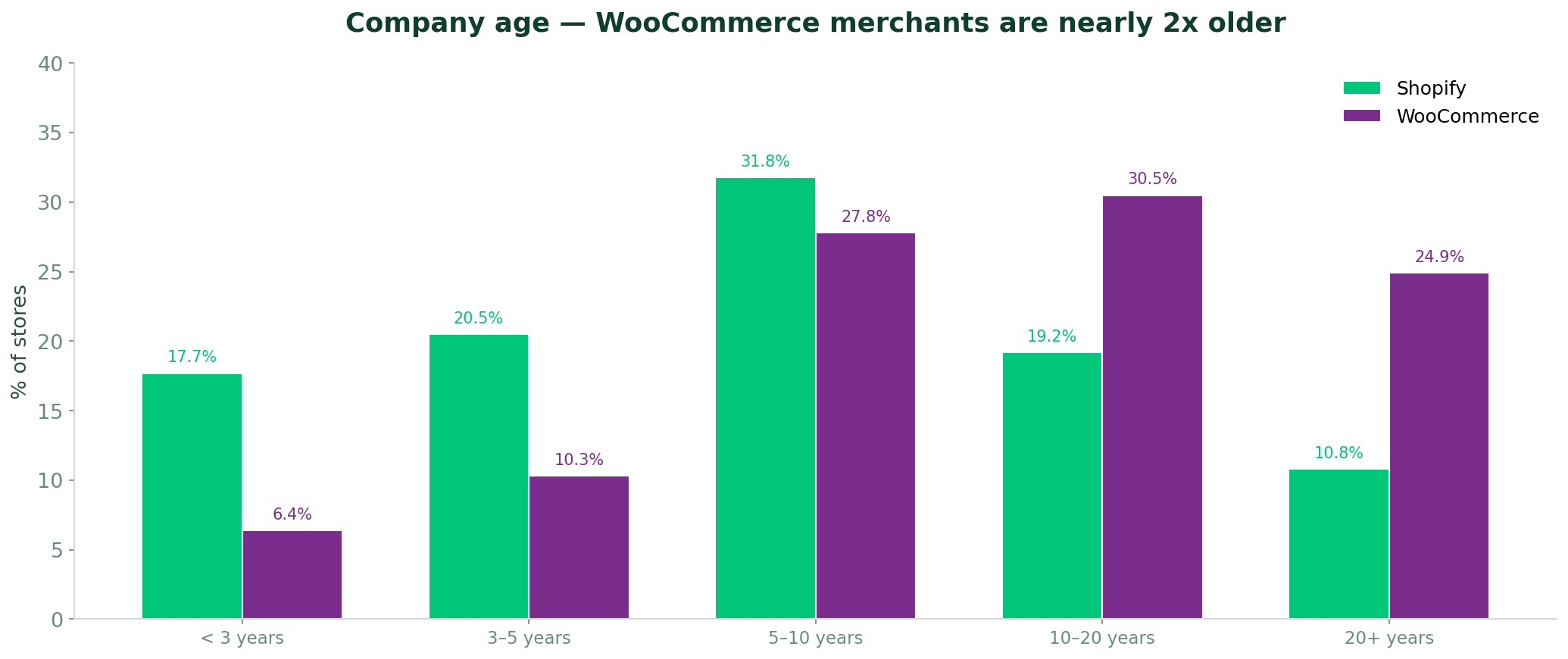
The structural characteristics of merchants on each platform confirm what the geography and industry data suggest. These are two distinct populations.
Company size
| Size category | Shopify | WooCommerce |
|---|---|---|
| PME (SME) | 77.8% | 84.8% |
| ETI (mid-cap) | 1.6% | 2.0% |
| GE (large enterprise) | 0.5% | 0.3% |
WooCommerce is even more heavily weighted toward PMEs than Shopify: 84.8% versus 77.8%. Neither platform has meaningful large enterprise penetration. WooCommerce’s slight edge in ETI representation (2.0% vs 1.6%) likely reflects older companies that grew into mid-cap status while keeping their original WordPress infrastructure.
Legal form
| Legal structure | Shopify | WooCommerce |
|---|---|---|
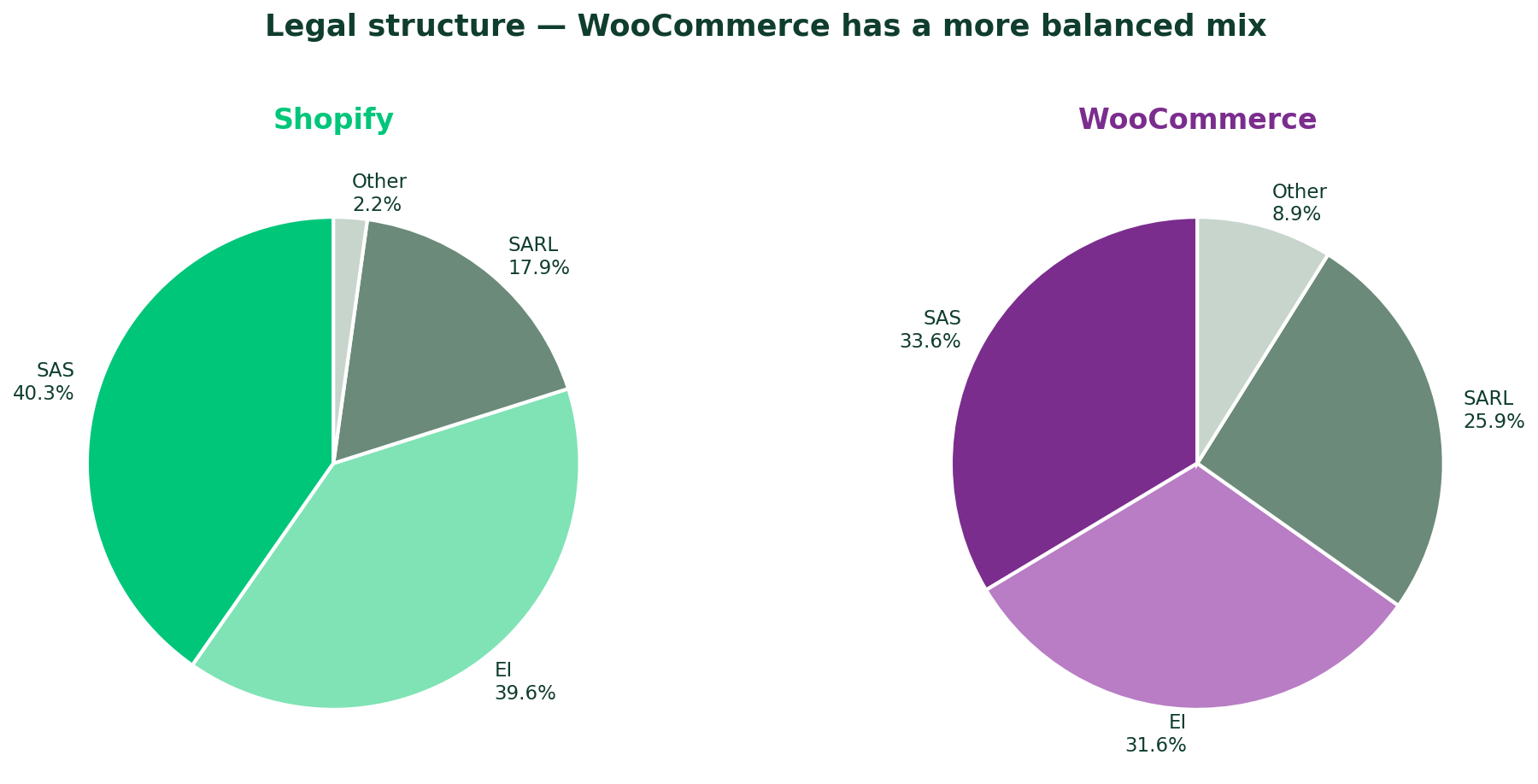
| SAS (simplified joint-stock) | 40.3% | 33.6% |
| EI (sole proprietor) | 39.6% | 31.6% |
| SARL (limited liability) | 17.9% | 25.9% |
Shopify has a more polarized legal profile: roughly equal shares of SAS and EI, with a small SARL segment. WooCommerce’s distribution is more balanced across all three forms. The SARL share is particularly notable — 25.9% on WooCommerce versus 17.9% on Shopify. SARLs require capital contributions and formal governance, and a platform with more than a quarter of its merchants operating under this structure is a platform of established, multi-partner businesses.
Company age
| Age bracket | Shopify | WooCommerce |
|---|---|---|
| Less than 3 years | 17.7% | 6.4% |
| 3 to 5 years | 20.5% | 10.3% |
| 5 to 10 years | 31.8% | 27.8% |
| 10 to 20 years | 19.2% | 30.5% |
| More than 20 years | 10.8% | 24.9% |
The age distribution draws a clear line between the two platforms. On Shopify, 38.2% of merchants are less than 5 years old. On WooCommerce, that figure is 16.7%. Conversely, 55.4% of WooCommerce merchants have been in business for more than 10 years, compared to 30.0% on Shopify. The median company age — 11 years on WooCommerce versus 6 years on Shopify — understates the gap because WooCommerce’s distribution has a long right tail of businesses that predate the internet entirely.
Domain extension (TLD)
| TLD | Shopify | WooCommerce |
|---|---|---|
| .com | 49.1% | 35.0% |
| .fr | 45.3% | 61.5% |
This is one of the cleanest signals in the dataset. WooCommerce merchants overwhelmingly choose .fr domains: 61.5%, compared to 45.3% on Shopify. Shopify merchants lean toward .com at 49.1%, while WooCommerce’s .com share is only 35.0%. WooCommerce is the “France-first” platform — its merchants build for the French market, use French domain extensions, and operate businesses registered in French provinces. Shopify is the “international-first” platform — .com majority, Paris-based, with a merchant profile oriented toward global or at least cross-border ambitions.
GMV and revenue distribution
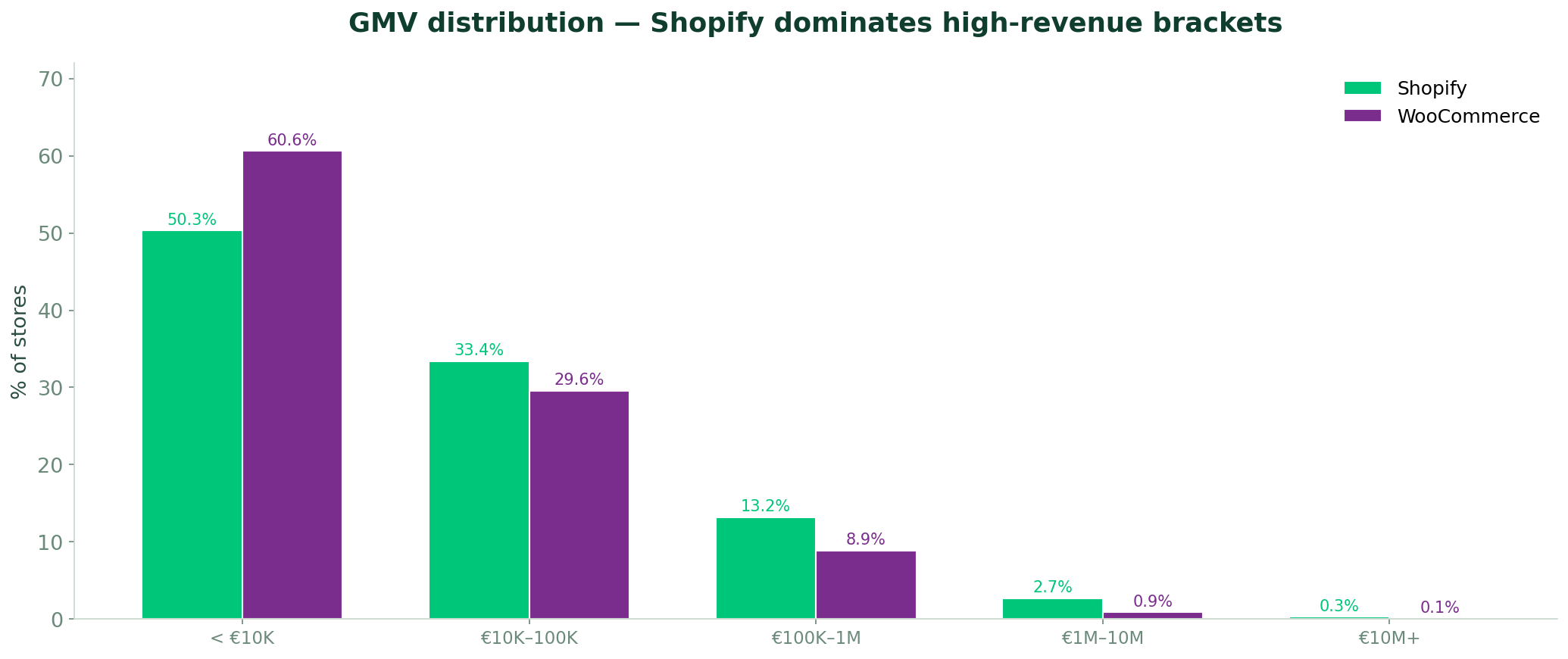
Revenue distribution is where Shopify’s smaller store count stops being a disadvantage and starts being irrelevant.
GMV brackets
| Annual GMV | Shopify | WooCommerce |
|---|---|---|
| Less than 10K EUR | 50.3% | 60.6% |
| 10K--100K EUR | 33.4% | 29.6% |
| 100K--1M EUR | 13.2% | 8.9% |
| 1M--10M EUR | 2.7% | 0.9% |
| More than 10M EUR | 0.3% | 0.1% |
More than 60% of WooCommerce stores generate less than 10,000 EUR in annual revenue. On Shopify, that figure is 50.3% — still high, but ten percentage points lower. The gap compounds at every tier above. In the 100K--1M bracket, Shopify holds 13.2% of its stores versus WooCommerce’s 8.9%. In the 1M--10M bracket, Shopify has 2.7% to WooCommerce’s 0.9% — a 3x ratio.
The top-line numbers are the starkest summary. Shopify’s 28,583 stores generate an estimated 5.87 billion EUR in total GMV. WooCommerce’s 60,563 stores generate 4.07 billion EUR. Shopify produces 44% more revenue from 53% fewer stores. The average Shopify store generates 205,272 EUR per year. The average WooCommerce store generates 67,236 EUR.
This does not mean WooCommerce stores are failing. It means the platform hosts a fundamentally different type of business. Many WooCommerce stores are secondary revenue channels for companies whose primary activity is services, manufacturing, or consulting. A consultancy selling a 49 EUR ebook does not need to generate 200,000 EUR in annual GMV to justify its WooCommerce installation. The plugin is free, the hosting is shared with the corporate site, and any revenue is incremental.
Verdict: which platform for which use case
The data does not support a blanket recommendation. It supports a segmentation argument: each platform serves a merchant population so distinct that comparing them on the same axes risks missing the point entirely.
Choose Shopify if:
You are launching a new direct-to-consumer brand, particularly in fashion, beauty, food, or lifestyle. You are based in or targeting Paris and the Ile-de-France market. You want managed hosting with no server administration. You need access to the Shopify app ecosystem for marketing, fulfillment, and payments. You prioritize speed to market over customization depth. Your business model is built around paid acquisition, social commerce, and brand storytelling.
Choose WooCommerce if:
You already operate a WordPress website and need to add e-commerce capability without rebuilding. Your primary business is not retail — you are a service provider, consultant, IT company, training organization, or creative professional who also sells products or takes payments online. You are based in provincial France and work with a local WordPress agency. You need full control over hosting, code, and data. You are budget-conscious and prefer open-source tools. You already have an internal technical team or a trusted developer relationship.
For B2B teams selling to merchants:
WooCommerce is the volume play. With 60,563 stores, it offers the largest addressable market of any single platform in France. But the average WooCommerce store generates a third of the revenue of the average Shopify store, and many are secondary channels for non-retail businesses. Shopify is the value play. Fewer stores, but higher revenue per store, more Leaders, and a merchant base more likely to invest in tools, apps, and services. A WooCommerce-first strategy maximizes pipeline breadth. A Shopify-first strategy maximizes revenue per account.
Frequently Asked Questions
Is Shopify or WooCommerce more popular in France?
WooCommerce is the most widely used e-commerce platform in France by a substantial margin. With 60,563 active stores, it holds 46.9% of the market — more than double Shopify’s 28,583 stores and 22.1% share. However, popularity by store count does not translate to revenue leadership. Shopify’s total estimated GMV (5.87 billion EUR) exceeds WooCommerce’s (4.07 billion EUR) by 44%, and Shopify has 3.7 times more high-traffic Leader stores.
Which generates more revenue in France --- Shopify or WooCommerce?
Shopify generates more total revenue despite having fewer stores. Shopify’s estimated total GMV is 5.87 billion EUR compared to WooCommerce’s 4.07 billion EUR. The average Shopify store generates 205,272 EUR per year versus 67,236 EUR on WooCommerce — a 3.1x gap. This disparity reflects the different nature of the two merchant bases: Shopify stores are primarily retail businesses optimized for online sales, while many WooCommerce stores are secondary channels for non-retail companies.
What type of business uses WooCommerce vs Shopify in France?
Shopify is dominated by retail commerce: 57.2% of its stores are classified under Commerce. WooCommerce is far more diversified, with only 29.8% in Commerce and significant representation in professional services (9.2%), IT (8.6%), other services (7.4%), and arts and leisure (5.1%). WooCommerce merchants tend to be older companies (median age 11 years vs 6 years on Shopify), more likely to use .fr domains (61.5% vs 45.3%), and more likely to operate as SARLs (25.9% vs 17.9%).
Where are Shopify and WooCommerce stores located in France?
Shopify is heavily concentrated in the Paris region, with 37.9% of stores in Ile-de-France. WooCommerce is the most geographically distributed major platform in France, with only 19.2% in Ile-de-France and stronger representation in Auvergne-Rhone-Alpes (14.9%), Occitanie (10.8%), and Nouvelle-Aquitaine (10.0%). Outside Paris, WooCommerce holds a larger share than Shopify in every major region.
Is WooCommerce free? How does the cost compare to Shopify?
WooCommerce is a free, open-source WordPress plugin. There is no license fee. However, total cost of ownership includes hosting (typically 10--50 EUR per month for a small store), SSL certificates, premium themes, paid extensions for payment gateways, shipping, and SEO, plus developer time for setup and maintenance. Shopify charges a monthly subscription starting at 36 EUR for its Basic plan, which includes hosting, SSL, and a payment gateway. For a solo entrepreneur with no technical skills, Shopify’s predictable monthly fee is often cheaper than WooCommerce’s accumulated costs. For a business with an existing WordPress site and a developer on staff, WooCommerce’s marginal cost approaches zero.
How many Shopify and WooCommerce stores are there in France?
As of June 2026, lebot.in’s database identifies 28,583 active Shopify stores and 60,563 active WooCommerce stores in France, each matched to a verified SIREN (French legal entity number). Combined, the two platforms account for 89,146 stores, or 69.0% of the 155,000 e-commerce businesses in the database. WooCommerce alone represents nearly half the entire French e-commerce market by store count.
Methodology
All data in this article comes from lebot.in’s June 2026 database of 155,000 French e-commerce businesses. Each store is matched to a SIREN — the nine-digit French legal entity registration number assigned by INSEE. Platform detection uses technology fingerprinting across live websites. Traffic estimates are sourced from SimilarWeb data. GMV estimates are modeled from traffic volumes, industry-specific conversion rates, and average order values. Company metadata (legal form, age, size classification, NAF sector code, region) is sourced from official French business registries. For a full description of the database and its coverage, see the June 2026 database overview.
Further Reading
- [French E-Commerce Database: 155,000 Online Stores Mapped](https://www.lebot.in/en/insights/french-ecommerce-database-june-2026) --- the full June 2026 database overview with platform, region, and legal entity breakdowns.
- [Shopify in France --- May 2026: 28,228 Active Stores](https://www.lebot.in/en/insights/shopify-france-may-2026) --- deep dive into Shopify’s French merchant base, industry verticals, and revenue estimates.
- [PrestaShop vs Shopify in France: 23,479 vs 28,583 Stores Compared by Data](https://www.lebot.in/en/insights/battlecard-prestashop-vs-shopify-france) --- head-to-head data comparison of PrestaShop and Shopify in the French market.
- [StoreLeads Alternative: Benchmarking Shopify France](https://www.lebot.in/en/insights/storeleads-alternative-benchmark-shopify-france) --- how lebot.in’s database compares to StoreLeads for Shopify store intelligence in France.

Your prospects are in our database. Let's talk.
Our team is available to present the solution and help you build your first e-commerce prospect segment.
Book a meeting →