.jpg)
PrestaShop vs Shopify in France: 23,479 vs 28,583 Stores Compared by Data
The comparison that actually matters
Most PrestaShop vs Shopify comparisons focus on features, pricing plans, or ease of use. Those articles are useful if you are choosing a platform for a new store. They are less useful if you need to understand the French e-commerce market as it actually exists today — who uses each platform, how much revenue they generate, and where they operate.
This article takes a different approach. Instead of reviewing features, we analyzed the installed base of both platforms across 155,000 SIREN-verified French e-commerce businesses in lebot.in's June 2026 database. Every figure below comes from that dataset: real stores, matched to real legal entities, with traffic estimates, revenue modeling, and geographic breakdowns.
The result is not a recommendation. It is a data portrait of two very different merchant populations that happen to compete in the same market.
Scorecard: key metrics head to head
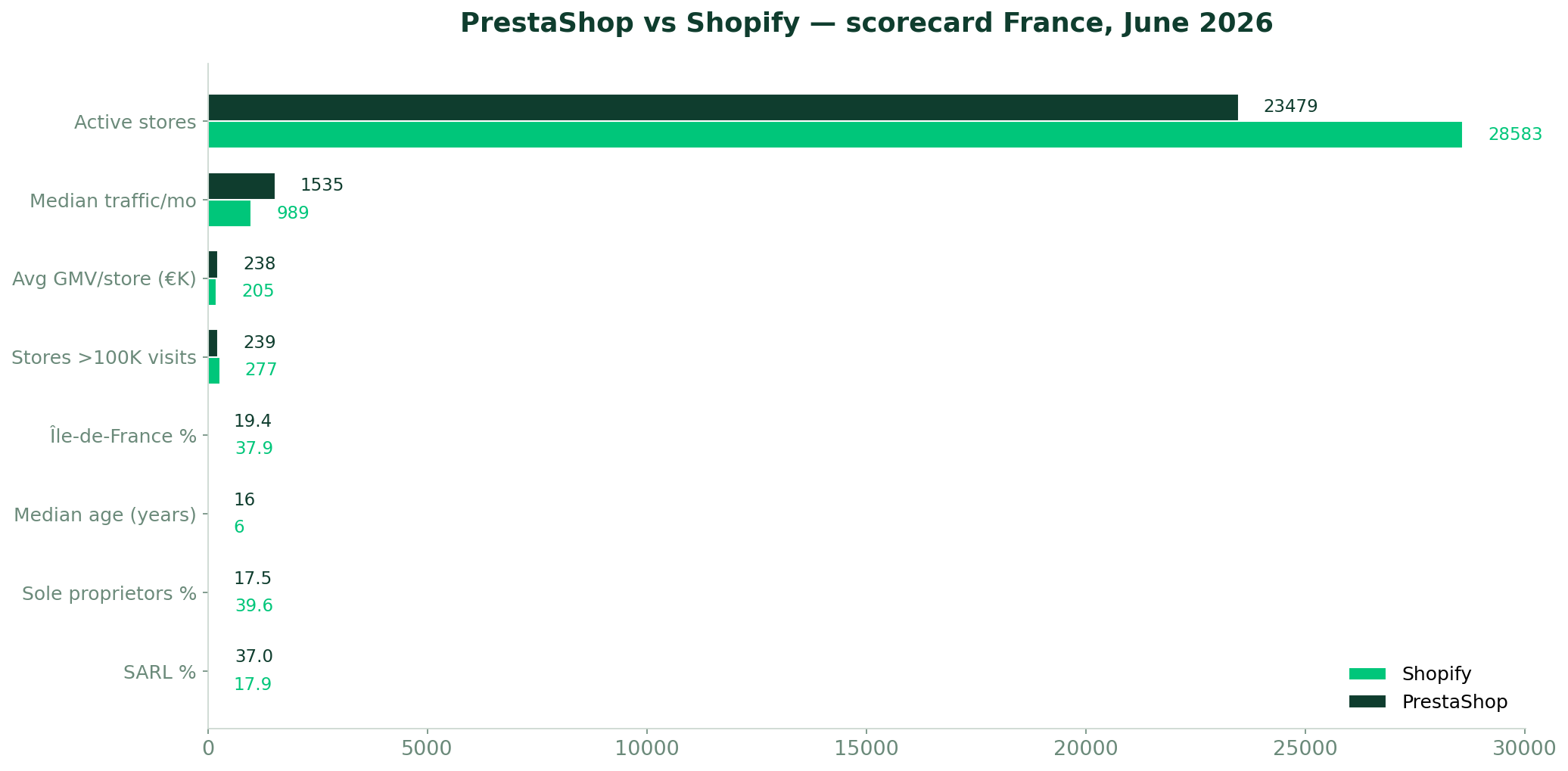
Before diving into the details, here is the summary comparison across eight dimensions that define each platform's position in France.
| Metric | Shopify | PrestaShop |
|---|---|---|
| Active stores | 28,583 | 23,479 |
| Market share (France) | 22.1% | 18.2% |
| Median monthly traffic | 989 | 1,535 |
| Total estimated GMV | 5.87B EUR | 5.59B EUR |
| Average GMV per store | 205,272 EUR | 238,266 EUR |
| Stores with >100K visits/mo | 277 | 239 |
| Median company age | 6 years | 16 years |
| Ile-de-France concentration | 37.9% | 19.4% |
The scorecard tells the story at a glance. Shopify leads in store count by roughly 5,100 units, giving it a 3.9-percentage-point market share advantage. But PrestaShop stores outperform on a per-unit basis: higher median traffic (1,535 vs 989 monthly visits), higher average revenue (238,266 EUR vs 205,272 EUR per store), and a total GMV gap of only 280 million EUR despite having 18% fewer stores.
The median company age is the starkest difference. PrestaShop merchants have been in business for 16 years on average. Shopify merchants, 6 years. These are not two versions of the same merchant. They are two distinct populations operating in the same economy.
Traffic and performance distribution
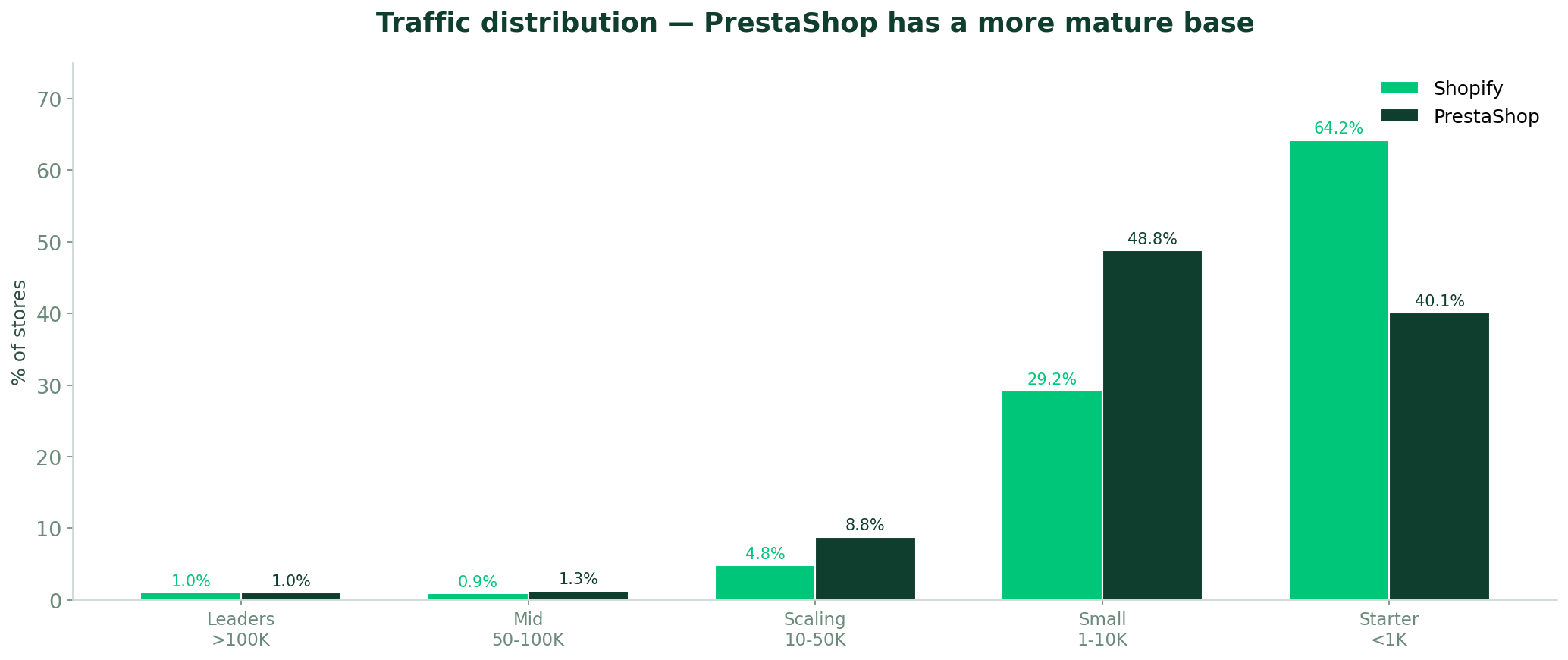
Raw store counts can be misleading. The traffic distribution reveals whether a platform's base is actively trading or mostly dormant.
Shopify traffic segments
| Segment | Monthly visits | Share of stores |
|---|---|---|
| Starters | <1,000 | 64.2% |
| Small | 1,000--10,000 | 29.2% |
| Scaling | 10,000--40,000 | 4.8% |
| Mid-market | 40,000--100,000 | 0.9% |
| Leaders | >100,000 | 1.0% |
PrestaShop traffic segments
| Segment | Monthly visits | Share of stores |
|---|---|---|
| Starters | <1,000 | 40.1% |
| Small | 1,000--10,000 | 48.8% |
| Scaling | 10,000--40,000 | 8.8% |
| Mid-market | 40,000--100,000 | 1.3% |
| Leaders | >100,000 | 1.0% |
The distribution gap is significant. Nearly two-thirds of Shopify stores (64.2%) fall into the Starter category with fewer than 1,000 monthly visits. On PrestaShop, that figure drops to 40.1%. Meanwhile, PrestaShop's Small segment (1,000--10,000 visits) holds 48.8% of its stores compared to only 29.2% on Shopify.
PrestaShop has a much more mature traffic distribution. Its base is anchored in the 1K--10K range — stores that are actively trading and generating meaningful revenue. Shopify's base is skewed toward micro-stores, many of which may be dormant or recently launched. At the top end, both platforms have roughly the same number of Leaders (277 vs 239), confirming that high-traffic success is possible on either platform.
Industry verticals
Both platforms are dominated by Commerce (retail trade), but the composition of the remaining sectors diverges in instructive ways.
Shopify: top sectors by NAF code classification
| Sector | Share of stores |
|---|---|
| Commerce (retail/wholesale) | 57.2% |
| Manufacturing | 18.0% |
| Professional services | 6.3% |
| IT and communications | 4.6% |
PrestaShop: top sectors by NAF code classification
| Sector | Share of stores |
|---|---|
| Commerce (retail/wholesale) | 63.6% |
| Manufacturing | 14.7% |
| IT and communications | 5.0% |
| Professional services | 3.7% |
| Agriculture | 2.4% |
PrestaShop skews more heavily toward pure retail, with 63.6% of its stores classified under Commerce compared to 57.2% on Shopify. Shopify compensates with a stronger presence in Professional Services (6.3% vs 3.7%) and a broader representation of IT and communications businesses.
The most distinctive gap is Agriculture. PrestaShop holds 2.4% of its base in agricultural businesses — producers selling direct, cooperatives with online storefronts, and specialty food operations rooted in French terroir. This segment is negligible on Shopify. It reflects PrestaShop's deeper penetration into traditional French business sectors, particularly in rural regions where self-hosted solutions and local web agencies have historically dominated.
Geography: where each platform dominates
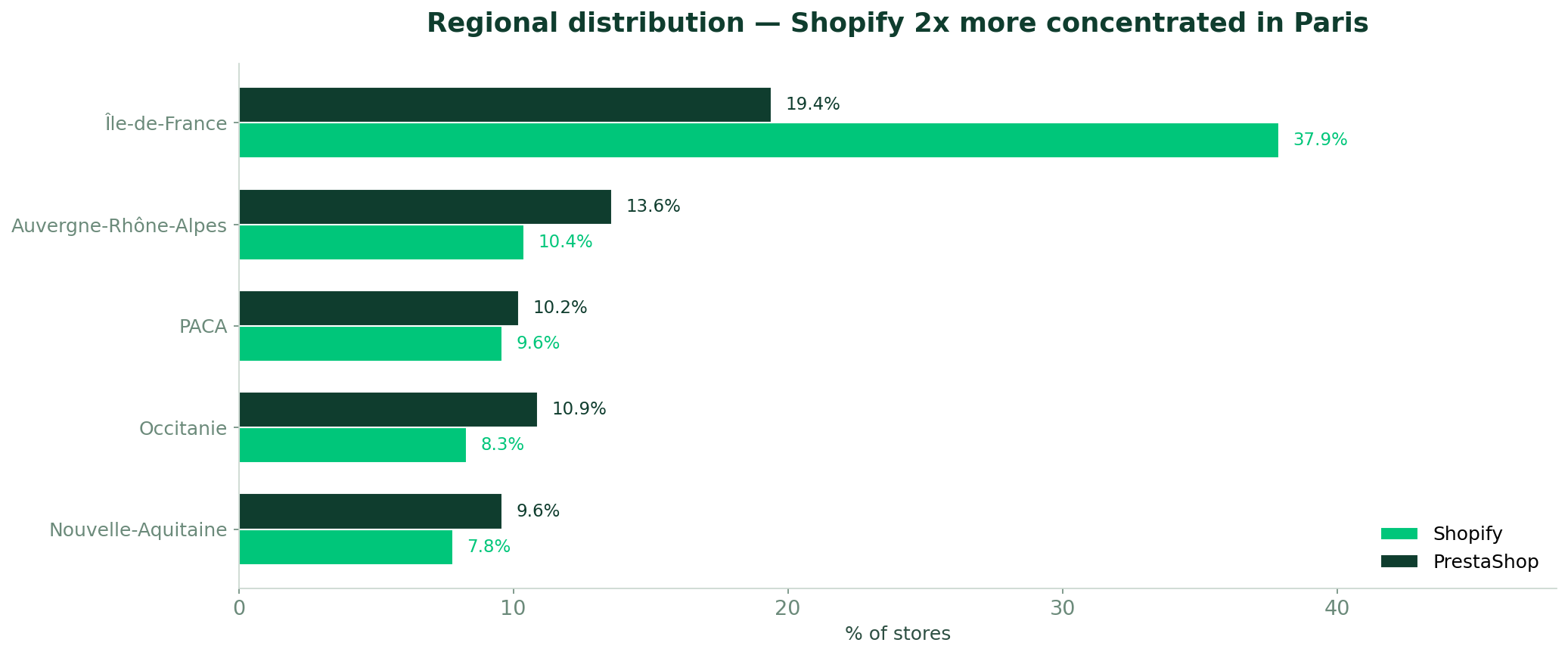
Where a merchant is located correlates strongly with which platform they choose. The geographic footprints of Shopify and PrestaShop could hardly be more different.
Shopify: regional distribution
| Region | Share of stores |
|---|---|
| Ile-de-France | 37.9% |
| Auvergne-Rhone-Alpes | 10.4% |
| Provence-Alpes-Cote d'Azur | 9.6% |
| Occitanie | 8.3% |
| Nouvelle-Aquitaine | 7.8% |
PrestaShop: regional distribution
| Region | Share of stores |
|---|---|
| Ile-de-France | 19.4% |
| Auvergne-Rhone-Alpes | 13.6% |
| Occitanie | 10.9% |
| Provence-Alpes-Cote d'Azur | 10.2% |
| Nouvelle-Aquitaine | 9.6% |
Shopify's geographic concentration is striking. Nearly 38% of all French Shopify stores are registered in Ile-de-France — almost double PrestaShop's 19.4% in the same region. This reflects Shopify's appeal to the Paris-based DTC and lifestyle brand ecosystem, where venture-backed startups, digital-native brands, and influencer-driven commerce are concentrated.
PrestaShop's distribution is far more balanced. Outside Ile-de-France, PrestaShop actually holds more stores than Shopify in most regions — Auvergne-Rhone-Alpes (13.6% vs 10.4%), Occitanie (10.9% vs 8.3%), and Nouvelle-Aquitaine (9.6% vs 7.8%). This geographic spread mirrors its merchant profile: established businesses, often family-owned, operating from provincial France.
For B2B teams targeting French merchants, this distinction has direct implications for go-to-market strategy. A Paris-centric campaign will over-index on Shopify stores. A regionally distributed outreach program will find a much richer PrestaShop base.
Company profile: who uses each platform
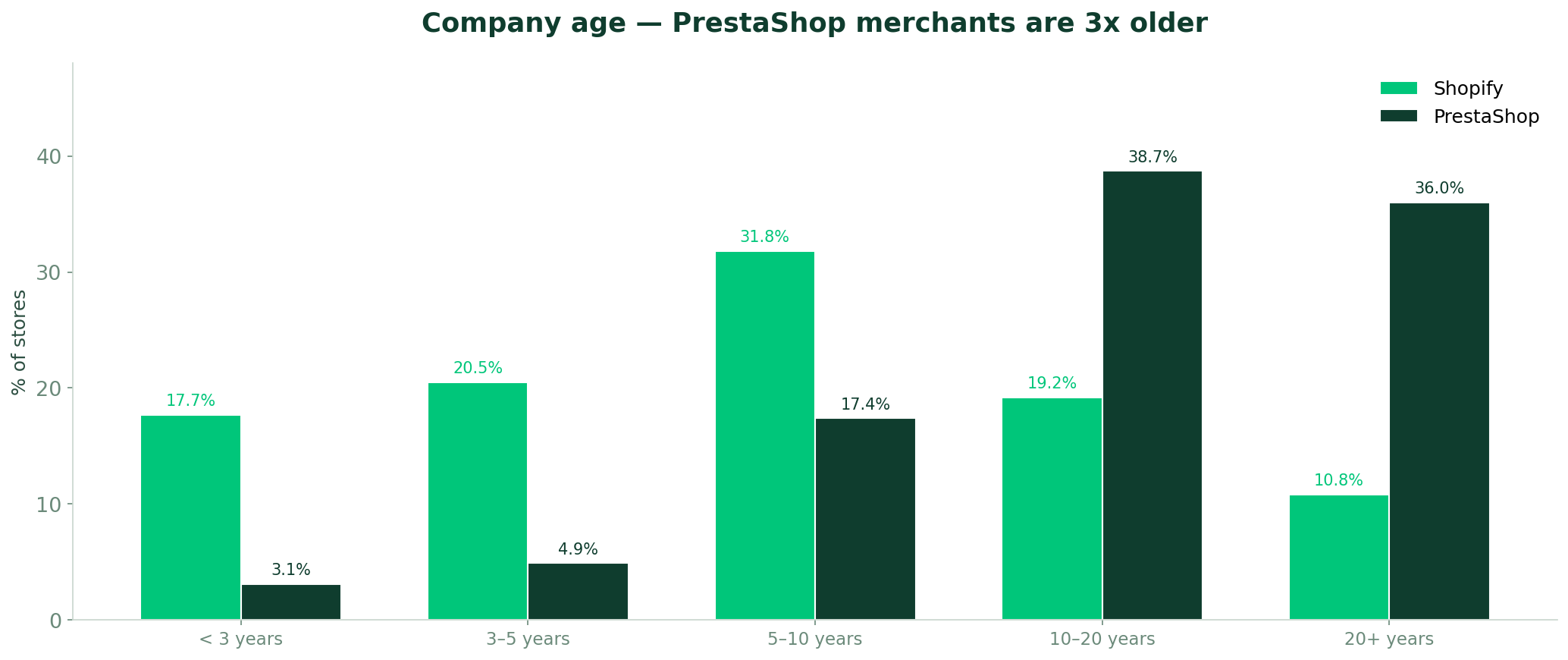
The legal and structural characteristics of merchants on each platform reveal the deepest differences.
Company size
| Size category | Shopify | PrestaShop |
|---|---|---|
| PME (SME) | 77.8% | 89.6% |
| ETI (mid-cap) | 1.6% | 4.0% |
| GE (large enterprise) | 0.5% | 0.4% |
PrestaShop has a significantly higher share of ETI (mid-cap) companies at 4.0% compared to Shopify's 1.6%. These are businesses with 250+ employees and substantial revenue — the segment where customization and ERP integration matter most.
Legal form
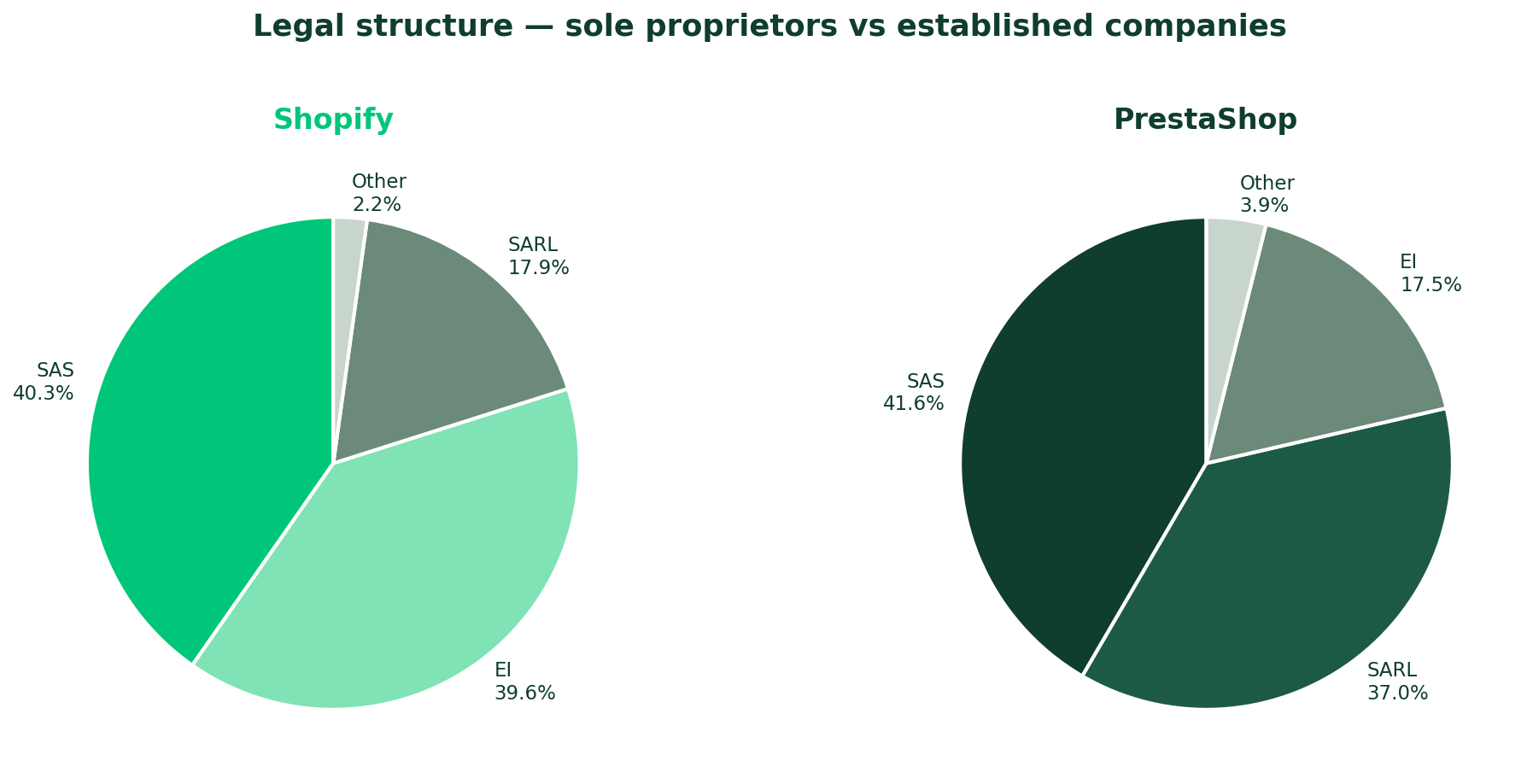
| Legal structure | Shopify | PrestaShop |
|---|---|---|
| SAS (simplified joint-stock) | 40.3% | 41.6% |
| EI (sole proprietor) | 39.6% | 17.5% |
| SARL (limited liability) | 17.9% | 37.0% |
This is one of the most telling comparisons in the entire dataset. Shopify merchants are twice as likely to be sole proprietors (EI) at 39.6% compared to PrestaShop's 17.5%. Conversely, PrestaShop merchants are twice as likely to operate as SARLs at 37.0% versus 17.9% on Shopify. The SAS share is virtually identical on both platforms.
The EI-to-SARL ratio functions as a proxy for business maturity. Entreprises individuelles are the default form for solo entrepreneurs launching their first venture. SARLs require capital contributions and formal governance. A platform where 37% of merchants are SARLs is a platform of established, structured businesses.
Company age
| Age bracket | Shopify | PrestaShop |
|---|---|---|
| Less than 3 years | 17.7% | 3.1% |
| 3 to 5 years | 20.5% | 4.9% |
| 5 to 10 years | 31.8% | 17.4% |
| 10 to 20 years | 19.2% | 38.7% |
| More than 20 years | 10.8% | 36.0% |
The age distribution makes the narrative unmistakable. Over 74% of PrestaShop merchants have been in business for more than 10 years. On Shopify, 38.2% of merchants are less than 5 years old. PrestaShop is the platform of established French commerce. Shopify is the platform of new entrants.
Domain extension (TLD)
| TLD | Shopify | PrestaShop |
|---|---|---|
| .com | 49.1% | 46.5% |
| .fr | 45.3% | 49.3% |
PrestaShop merchants slightly prefer the .fr extension (49.3% vs 45.3%), consistent with their profile as locally rooted, French-market-focused businesses. Shopify merchants lean toward .com, reflecting a more international or brand-driven orientation. The difference is modest but directionally consistent with every other data point.
GMV and revenue distribution
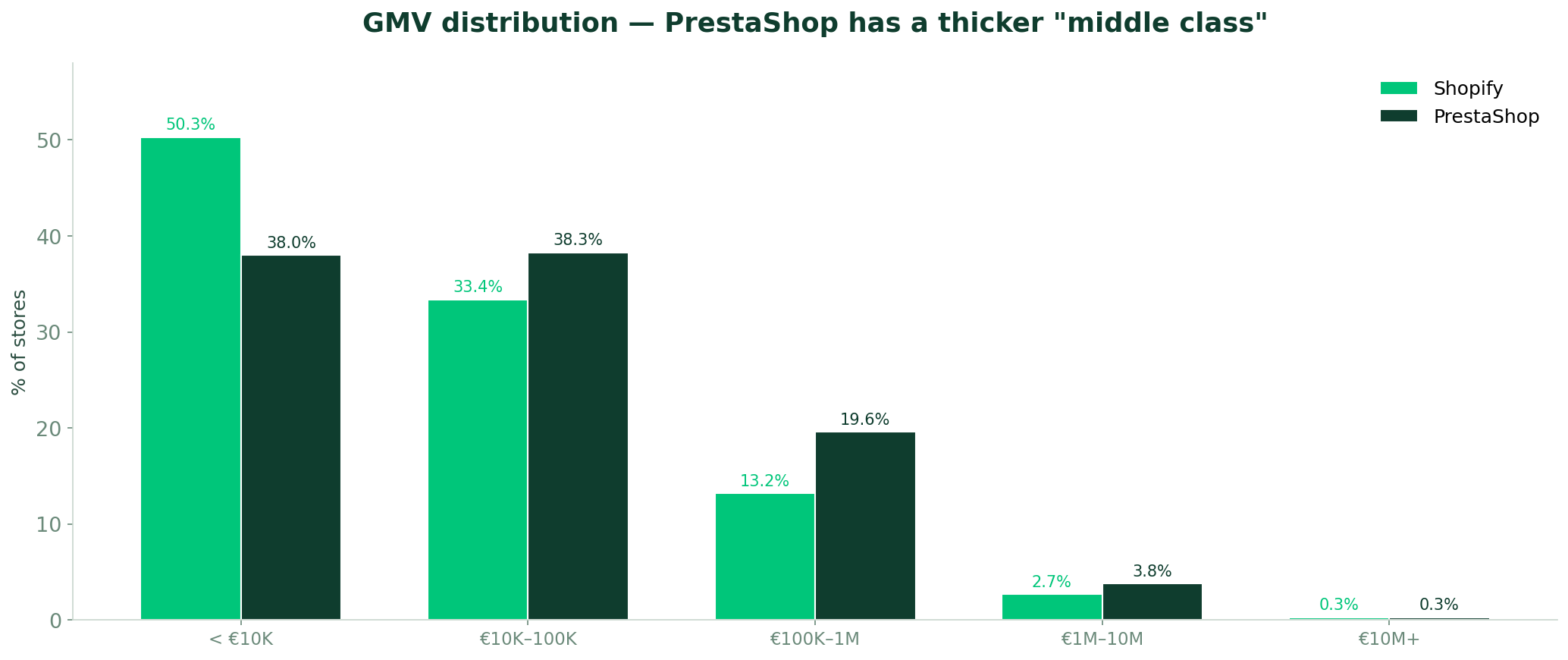
GMV brackets
| Annual GMV | Shopify | PrestaShop |
|---|---|---|
| Less than 10K EUR | 50.3% | 38.0% |
| 10K--100K EUR | 33.4% | 38.3% |
| 100K--1M EUR | 13.2% | 19.6% |
| 1M--10M EUR | 2.7% | 3.8% |
| More than 10M EUR | 0.3% | 0.3% |
Half of all Shopify stores in France generate less than 10,000 EUR in annual revenue. On PrestaShop, that figure is 38%. The gap widens in the critical 100K--1M EUR bracket: 19.6% of PrestaShop stores versus 13.2% of Shopify stores fall into this range.
PrestaShop has a thicker "middle class" of commercially viable businesses. For any company selling services or infrastructure to French online merchants, the 100K--1M segment is the sweet spot — and PrestaShop has a 50% larger share of it than Shopify.
At the very top (10M+ EUR), both platforms are identical at 0.3%, representing roughly 85 Shopify stores and 70 PrestaShop stores. Enterprise-scale success exists on both platforms, but it is rare on either.
Verdict: which platform for which use case
The data does not support a blanket statement that one platform is "better" than the other. It supports a segmentation argument: each platform serves a distinct merchant population, and the right choice depends on who you are and what you are building.
Choose Shopify if:
You are launching a new direct-to-consumer brand, particularly in fashion, beauty, or lifestyle. You are based in Paris or targeting international markets. You prioritize speed to market, app ecosystem breadth, and low upfront technical investment. You are comfortable with a hosted model where the platform controls the infrastructure. Your business model is brand-driven, with social commerce and paid acquisition as primary channels.
Choose PrestaShop if:
You are an established business migrating to e-commerce or upgrading from an older system. You need deep customization, multi-warehouse management, or integration with existing French ERP and accounting systems. You operate from provincial France and work with a local web agency. Your business is B2B, niche retail, or agricultural. You want to own your technical stack and hosting environment.
For B2B teams selling to merchants:
The two bases require fundamentally different go-to-market approaches. Shopify merchants are younger, Paris-centric, brand-oriented, and reachable through digital channels. PrestaShop merchants are older, geographically distributed, operations-focused, and more likely to respond to regional sales presence and trade events. A single campaign targeting "French e-commerce merchants" without platform segmentation will underperform on both audiences.
Frequently Asked Questions
Is PrestaShop or Shopify more popular in France?
Shopify has more active stores (28,583 vs 23,479), giving it a 22.1% market share compared to PrestaShop's 18.2% of the 155,000 e-commerce businesses tracked in lebot.in's June 2026 database. However, both trail WooCommerce, which leads the French market at 46.9%. Popularity depends on how you measure it — by store count, Shopify leads; by revenue per store or merchant maturity, PrestaShop holds the advantage.
Which platform generates more revenue per store in France?
PrestaShop stores generate an average of 238,266 EUR in annual GMV compared to 205,272 EUR for Shopify stores. The gap is driven by PrestaShop's more mature merchant base: older companies, more established legal structures, and higher median traffic (1,535 vs 989 monthly visits). Total platform GMV is closer — 5.87 billion EUR for Shopify versus 5.59 billion EUR for PrestaShop — because Shopify compensates with store volume.
Where are PrestaShop and Shopify stores located in France?
Shopify is heavily concentrated in Ile-de-France, with 37.9% of its stores registered in the Paris region. PrestaShop is much more evenly distributed: only 19.4% in Ile-de-France, with strong representation in Auvergne-Rhone-Alpes (13.6%), Occitanie (10.9%), and Provence-Alpes-Cote d'Azur (10.2%). Outside Paris, PrestaShop holds more stores than Shopify in most French regions.
What type of business uses PrestaShop vs Shopify?
PrestaShop merchants are predominantly established companies: 37% are SARLs, 74% have been in business for over 10 years, and 89.6% are classified as PME (SME). Shopify merchants skew younger and lighter: 39.6% are sole proprietors (EI), 38.2% are less than 5 years old, and the platform has a strong presence in fashion, beauty, and lifestyle segments. PrestaShop is the platform of established French commerce; Shopify is the platform of new entrants.
Is PrestaShop declining in France?
PrestaShop's share among newly created stores has decreased relative to Shopify in recent years, but its installed base remains substantial at 23,479 stores. More importantly, its stores tend to be more commercially mature, with higher average revenue and traffic than Shopify stores. PrestaShop is not so much declining as it is shifting — from a growth platform to an incumbency platform, holding a loyal base of established merchants while Shopify captures the majority of new entrants.
How many PrestaShop and Shopify stores are there in France in 2026?
As of June 2026, lebot.in's database identifies 28,583 active Shopify stores and 23,479 active PrestaShop stores in France, each matched to a verified SIREN (French legal entity number). Combined, the two platforms account for 52,062 stores, or 40.3% of the 155,000 e-commerce businesses in the database.
Methodology
All data in this article comes from lebot.in's June 2026 database of 155,000 French e-commerce businesses. Each store is matched to a SIREN — the nine-digit French legal entity registration number assigned by INSEE. Platform detection uses technology fingerprinting across live websites. Traffic estimates are sourced from SimilarWeb data. GMV estimates are modeled from traffic volumes, industry-specific conversion rates, and average order values. Company metadata (legal form, age, size classification, NAF sector code, region) is sourced from official French business registries. For a full description of the database and its coverage, see the June 2026 database overview.
Further Reading
- French E-Commerce Database: 155,000 Online Stores Mapped — the full June 2026 database overview with platform, region, and legal entity breakdowns.
- Shopify in France — May 2026: 28,228 Active Stores — deep dive into Shopify's French merchant base, industry verticals, and revenue estimates.
- PrestaShop in France — May 2026 — comprehensive analysis of PrestaShop's position, traffic distribution, and regional footprint.
- StoreLeads Alternative: Benchmarking Shopify France — how lebot.in's database compares to StoreLeads for Shopify store intelligence in France.

Your prospects are in our database. Let's talk.
Our team is available to present the solution and help you build your first e-commerce prospect segment.
Book a meeting →